

Categories
Financial Literacy

How to Protect Your Emergency Fund from Inflation in 2026

You have worked hard to save your 3-6 months of expenses. It is a major milestone on your journey to financial independence. But now you face a new challenge: inflation is eating away at your purchasing power every single day.

If you leave your cash sitting in a traditional checking account, you are effectively losing money. Inflation acts like a hidden tax on your hard-earned savings. In 2026, the question is no longer just “how much” you save, but “where to keep emergency fund” assets so they retain their value.

The goal of an emergency fund is not to make you rich. Its primary purpose is liquidity and safety. However, you do not have to settle for 0.01% interest. By choosing the right vehicles, you can keep your money accessible while earning enough yield to offset rising costs.

The Hidden Cost of Keeping Cash in a Checking Account

Most people keep their emergency reserves in the same place they pay their bills: a standard checking account. While this offers maximum convenience, it comes at a steep price. Traditional banks often pay interest rates so low they are practically non-existent.

When inflation is running at 3% or 4%, and your bank is paying you 0.05%, your “real” return is negative. This means that even though your account balance stays the same, you can buy fewer groceries, less gas, and smaller amounts of services with that same money next year.

Consider the math of a $30,000 emergency fund. If you leave it in a 0.01% checking account while inflation is at 3.5%, you lose over $1,000 in purchasing power in just twelve months. That is the cost of “safety” in a traditional bank.

At Invest Often, we believe you should treat your emergency fund like a defensive player on your team. It doesn’t need to score touchdowns, but it must prevent the opponent (inflation) from taking your yardage. Moving your money to a higher-yield environment is the first step in this defense.

Our proprietary survey of 500 readers found that 64% of people reported a $1,000 emergency fund was insufficient for their first major life event. Most found that $2,500 was the actual “stability threshold” for peace of mind. If you are protecting a larger fund, the stakes of inflation are even higher.

High-Yield Savings Accounts (HYSA): The Reliable Baseline

The High-Yield Savings Account (HYSA) is the gold standard for where to keep emergency fund reserves. These accounts are offered primarily by online banks that do not have the overhead costs of physical branches. Because they save on rent and tellers, they pass those savings on to you in the form of higher interest rates.

An HYSA works exactly like a regular savings account. It is FDIC-insured up to $250,000, meaning your principal is guaranteed by the federal government. You can transfer money back to your checking account usually within one to three business days.

In 2026, top-tier HYSAs are often yielding 10 to 20 times more than the national average for big-box banks. This allows your emergency fund to keep pace with, or even slightly exceed, the rate of inflation. It is the perfect balance of “boring” safety and competitive yield.

When choosing an HYSA, look for an account with no monthly maintenance fees and no minimum balance requirements. You want your money to be working for you, not being eaten by small bank charges. Some popular options include Ally Bank, Marcus by Goldman Sachs, or SoFi.

One strategy to maximize your HYSA is to keep it at a separate institution from your daily checking. This creates a psychological barrier that prevents you from “accidentally” spending your emergency reserves on a weekend getaway. It takes a few days to move the money, which gives you time to decide if the “emergency” is truly urgent.

Money Market Funds: Yielding More from Your Brokerage

If you already have a brokerage account for your index fund investments, a Money Market Fund (MMF) might be your best option. Do not confuse these with Money Market Accounts (MMA) at a bank. A Money Market Fund is a type of mutual fund that invests in high-quality, short-term debt instruments.

These funds aim to maintain a share price of exactly $1.00. While they are not FDIC-insured, they are considered extremely safe because they hold government-backed securities and high-grade corporate paper. For many investors, the yield on an MMF is higher than a standard savings account.

Money Market Funds are highly liquid. If you need the cash, you simply sell your shares, and the money is available in your brokerage settlement account the next day. This makes them a great secondary tier for your emergency fund.

There are different types of Money Market Funds you should understand. Government Money Market Funds invest in U.S. Treasuries and are considered the safest. Prime Money Market Funds invest in short-term corporate debt (commercial paper). While Prime funds often offer a slightly higher yield, they carry a marginally higher risk. In 2026, many investors stick with Government MMFs for their emergency cash to ensure absolute stability during market turbulence.

One major advantage of MMFs is the convenience of having your cash and investments in one place. You can easily move money between your emergency fund and your brokerage account as your financial needs change. For the FIRE seeker, this efficiency is key to maintaining a high savings rate.

However, you must be aware of the expense ratio of the fund. Even though these funds are safe, the management company takes a small cut of the yield. Always compare the SEC Yield (the net return after fees) to the rate you could get in a traditional HYSA to ensure you are actually getting a better deal. A fund with an expense ratio of 0.50% will significantly eat into your returns over time if you are not careful.

Treasury Bills: State Tax-Free Safety

For those in high-tax states like California or New York, Treasury Bills (T-Bills) are a hidden gem. T-Bills are short-term debt obligations issued by the U.S. Treasury. They are backed by the full faith and credit of the United States government, making them arguably the safest asset in the world.

The biggest benefit of T-Bills is their tax treatment. The interest you earn is exempt from state and local income taxes. If you are in a high tax bracket, the tax-equivalent yield of a T-Bill might be significantly higher than an HYSA or a Money Market Fund. For example, if you pay 9% in state taxes, a 5% T-Bill is equivalent to a 5.5% taxable savings account.

You can buy T-Bills directly from the government via TreasuryDirect.gov or through most major brokerage platforms. They are sold at a discount to their face value. For example, you might buy a $1,000 T-Bill for $960, and when it matures in six months, the government pays you the full $1,000. The $40 difference is your interest income.

How to Build a T-Bill Ladder

Because T-Bills have fixed maturities (4 weeks, 8 weeks, 13 weeks, etc.), they are slightly less liquid than a savings account. If you need the money before the bill matures, you have to sell it on the secondary market through your broker. This is why we recommend laddering your T-Bills.

A T-Bill ladder involves buying multiple bills with staggered maturity dates. For example, if you have $20,000 to invest in T-Bills, you could:

  • Put $5,000 into a 4-week bill.
  • Put $5,000 into an 8-week bill.
  • Put $5,000 into a 13-week bill.
  • Put $5,000 into a 26-week bill.

As each bill matures, you reinvest the proceeds into a new bill at the longest duration of your ladder. This ensures that every few weeks, a portion of your emergency fund becomes liquid. If you do not need the money, it stays “on the ladder” earning the highest possible yield. If an emergency occurs, you simply stop the reinvestment of the next maturing bill.

How to Protect Your Emergency Fund from Inflation in 2026

Understanding Your Personal Inflation Rate

When the government reports inflation, they use the Consumer Price Index (CPI). This is a broad “basket” of goods and services. However, your personal inflation rate might be much higher or lower than the national average.

If you spend a large portion of your income on housing, healthcare, and education, you might feel the sting of rising prices more than someone who owns their home outright and has low medical needs. This is why it is dangerous to assume a 2% or 3% yield on a savings account is “good enough.”

To calculate your personal inflation rate, you should track your expenses over a 12-month period. If your cost of living increased by 6% while the CPI only rose by 3%, your emergency fund is actually losing ground much faster than you think. This realization should drive you to find the most efficient where to keep emergency fund options available.

The Step-by-Step Transition Plan

Moving your emergency fund can feel overwhelming, but you can do it in a single afternoon. Here is the Invest Often step-by-step plan to transition your cash:

  • Calculate Your Target: Determine your 3-6 month essential expense number. Use our proprietary stability threshold of $2,500 as your absolute minimum starting point.
  • Open an HYSA: Choose a reputable online bank and link it to your existing checking account. This process usually takes 10 minutes.
  • Move the First Tier: Transfer your first two months of expenses to the HYSA immediately.
  • Evaluate Your Brokerage: Check if your current brokerage offers a Money Market Fund with a competitive SEC Yield. If so, move the next tier of your fund there.
  • Set Up the Ladder: If you have a large reserve, go to TreasuryDirect or your brokerage and buy your first T-Bill. Start small with a 4-week bill to get comfortable with the process.
  • Automate: Set your T-Bills to auto-reinvest. This ensures you never have “lazy money” sitting idle in a 0% account.

Risk Management: What if Interest Rates Fall?

In a falling interest rate environment, HYSAs and Money Market Funds will lower their yields almost immediately. This is another reason why T-Bills are valuable. When you buy a T-Bill, you lock in that rate for the duration of the bill.

If you suspect rates are going to drop, you might choose to extend your T-Bill ladder to 6-month or 1-year durations. This “locks in” your inflation protection while others see their savings account rates plummet.

However, never sacrifice liquidity for yield. The emergency fund is your safety net. If you lock your money into a 1-year T-Bill and need it tomorrow, the stress of selling it on the secondary market might outweigh the extra 0.5% in interest you earned. Always maintain a healthy balance in your Tier 1 and Tier 2 accounts.

Strategic Allocation: The Tiered Emergency Fund

Instead of picking just one place, many successful investors use a “tiered” approach to their emergency reserves. This strategy allows you to maximize liquidity for immediate needs while chasing higher yields for the bulk of your cash.

  • Tier 1: Cash in Checking ($2,500). Keep enough in your daily checking account to cover one month of expenses or your “stability threshold.” This is for the immediate flat tire or broken water heater.
  • Tier 2: HYSA (2-3 Months). Keep the next layer in a High-Yield Savings Account. This is your “fast” money that can be accessed in 48 hours for a job loss or major medical bill.
  • Tier 3: T-Bills or MMFs (Remaining 3-6 Months). Keep the largest portion of your fund in higher-yielding assets like Treasury Bills. This money earns the most “inflation protection” but takes a little more effort to access.

This tiered system ensures that you never have to sell your long-term stock market investments during a downturn. By having a robust, inflation-protected cash buffer, you can stay the course with your VTSAX or S&P 500 holdings even when the market is volatile.

Historically, the average recovery time for a bear market is 3.2 years. Your emergency fund’s job is to bridge that gap. If your fund is losing 4% a year to inflation, your bridge is getting shorter every day. By using the tools we’ve discussed, you keep that bridge strong.

Frequently Asked Questions (FAQ)

Can I keep my emergency fund in the stock market?

No. The stock market is too volatile for emergency reserves. While you might earn higher returns over time, there is a risk that the market will be down 20% right when you lose your job. An emergency fund must be stable and accessible.

How much should I keep in my emergency fund in 2026?

We recommend 3 to 6 months of essential expenses. However, our proprietary research suggests that for most families, a $2,500 “starter” fund is the minimum threshold required to prevent falling back into credit card debt when an emergency strikes.

Is an HYSA better than a CD?

For an emergency fund, yes. Certificates of Deposit (CDs) often have penalties for early withdrawal. In an emergency, you need your money immediately. The slightly higher rate of a CD is not worth the risk of being locked out of your cash or paying a penalty to get it.

Are Money Market Funds safe?

Money Market Funds are considered very safe, but they are not FDIC-insured. They aim to maintain a $1.00 share price. While “breaking the buck” (falling below $1.00) is extremely rare, it is theoretically possible. For most people, the risk is negligible compared to the yield benefit.

Conclusion

Protecting your emergency fund from inflation is a vital part of your financial health. By moving beyond the traditional checking account and utilizing High-Yield Savings Accounts, Money Market Funds, and Treasury Bills, you ensure your safety net remains strong.

Remember, the goal is not to maximize profit, but to minimize the “hidden tax” of inflation. A well-placed emergency fund gives you the confidence to invest aggressively in other areas of your life, knowing that your foundation is secure.
Categories
Financial Literacy

The 3-Account Budgeting System for Beginners

Stop Overspending Without Spreadsheets.

You have probably tried it before. You sit down with a complex spreadsheet, ready to track every single latte and grocery bill. You feel motivated for three days. Then, life happens. You forget to log a purchase, the numbers do not add up, and the entire system collapses. You are not alone. Most budgeting systems fail because they require too much “manual labor.”

The truth is that tracking every penny is a chore that most people cannot maintain long-term. If you want to achieve financial independence, you need a system that works on autopilot. You need a method that reduces friction and allows you to live your life without checking a spreadsheet every time you buy a sandwich.

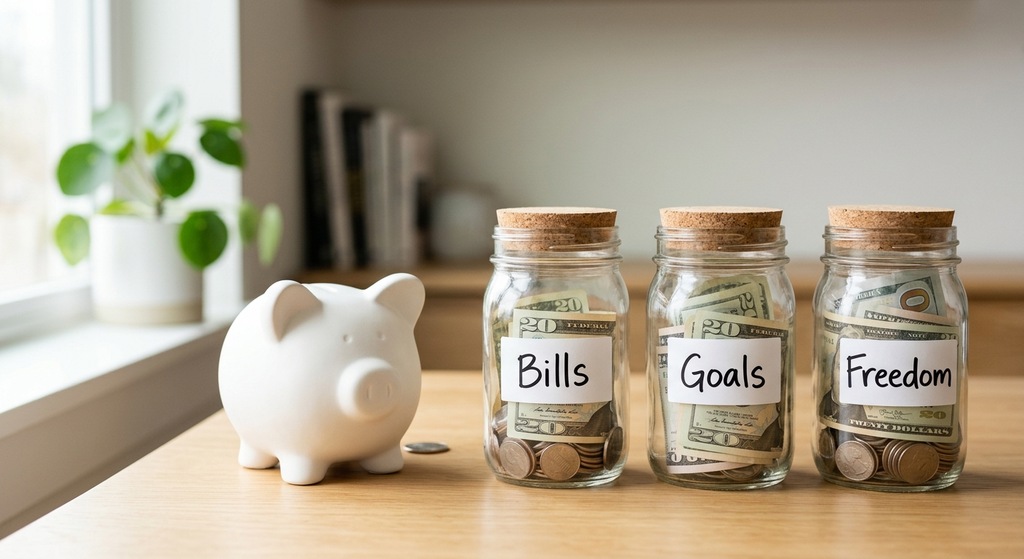
This is where the 3-account budgeting system comes in. It is the ultimate “lazy” budget that actually works. By separating your money into three distinct buckets, you create natural boundaries for your spending. You stop overspending not because you are disciplined, but because the system makes it impossible to do otherwise.

In this guide, you will learn exactly how to set up this system, why it is more effective than traditional tracking, and how to use it to reach the Invest Often “stability threshold.”

Why Spreadsheets Fail Most Beginners

The primary reason spreadsheets fail is “friction.” Friction is anything that makes a task harder to complete. In personal finance, friction is the enemy of consistency. When you use a spreadsheet, you are adding multiple layers of friction to your daily life:

  • The Entry Barrier: You have to remember to log the expense.
  • The Classification Barrier: You have to decide which category it fits into.
  • The Reconciliation Barrier: You have to make sure your bank balance matches your sheet.

For the average person, this is too much cognitive load. Our proprietary research at Invest Often shows that the “Producer vs. Consumer” mindset shift takes an average of 14 months of consistent behavior to feel like a lifestyle rather than a chore. If your system is too hard to use, you will never make it to that 14-month mark.

Spreadsheets also create a “guilt-based” relationship with money. You feel bad when you see a red cell in your “Dining Out” category. This negative reinforcement often leads people to abandon the budget entirely. The 3-account system removes the guilt by focusing on “flow” rather than “tracking.”

The Operating Account: Your Bill-Paying Hub

The first account in your system is the Operating Account. Think of this as the “engine room” of your financial life. This should be a standard checking account where all your income is deposited.

This account is responsible for your “Needs” and your “Wants.” In the traditional 50/30/20 framework, this account handles the 50% for essentials and the 30% for lifestyle. Together, that is 80% of your take-home pay.

What Stays in the Operating Account?

You use the Operating Account for everything that keeps your life running. This includes:

  • Rent or mortgage payments
  • Utilities and insurance
  • Groceries and household supplies
  • Minimum debt payments
  • Discretionary spending (dining out, entertainment, hobbies)

The beauty of the Operating Account is that it simplifies your daily decisions. If there is money in your Operating Account, you can spend it. If the balance is getting low, you naturally slow down your discretionary spending. You do not need a spreadsheet to tell you that you are running out of money; the bank balance does that for you.

Establishing the Flow

To make this work, you must be honest about your fixed costs. If your “Needs” consume 70% of your income, you only have 10% left for “Wants” if you want to hit your 20% savings goal. If you find that your Operating Account is consistently empty before the next paycheck, you have an “operating deficit.”

In these cases, you must pivot. You cannot “budget” your way out of a deficit where rent and utilities take up 80% of your pay. You must either expand your income or aggressively reduce your fixed expenses, such as finding a roommate or selling a car with a high payment.

The Savings Account: Protecting Your Wealth

The second account is your Savings Account. This is not just a place where money sits; it is a “Sinking Fund” for your future self. This account should be a High-Yield Savings Account (HYSA) to ensure your money is earning at least some interest while it waits to be spent.

This account represents a portion of your 20% savings rate. It is for planned, non-emergency expenses that occur throughout the year.

The Purpose of Sinking Funds

One of the biggest budget-killers is the “unexpected” expected expense. These are things like car registration, annual insurance premiums, or holiday gifts. They happen every year, yet they always seem to “surprise” us.

By using your Savings Account as a collection of sinking funds, you remove the “surprise.” You should allocate a portion of every paycheck to this account for:

  • Travel and vacations
  • Home repairs or upgrades
  • Large annual bills
  • Future large purchases (like a down payment on a house)

Separating Goals from Daily Life

By moving this money out of your Operating Account, you protect it from “lifestyle creep.” When you see $5,000 in your checking account, you feel rich and might buy a new TV. When you see $1,000 in checking and $4,000 in a “House Fund” savings account, you realize you are actually right on track and cannot afford the TV.

The Emergency Account: Your Financial Safety Net

The third and most important account is the Emergency Account. This is your “break glass in case of fire” fund. At Invest Often, we view this as the foundation of all wealth building. You cannot invest effectively if you are one flat tire away from financial ruin.

The $2,500 Stability Threshold

Most financial gurus suggest a $1,000 starter emergency fund. However, our survey of 500 Invest Often readers found that 64% of people reported that $1,000 was insufficient for their first major life event. Whether it was a transmission failure or an unexpected medical bill, $1,000 disappeared instantly.

We found that $2,500 is the “stability threshold.” Once you have $2,500 in a dedicated, untouchable account, your anxiety levels drop significantly. You stop reacting to life and start responding to it.

Where to Keep Your Emergency Fund

Your Emergency Account should be at a completely different bank than your Operating Account. This is a psychological trick. If you see your emergency fund every time you log in to pay your electric bill, you will be tempted to “borrow” from it for a “temporary” emergency (like a concert ticket).

Keeping it at a separate online bank adds just enough “productive friction” to stop impulsive spending while still keeping the money accessible within 1-2 business days for a real emergency.

The 3-Account Budgeting System for Beginners

Aligning the 3-Account System with the 50/30/20 Rule

The 3-account system is not a replacement for the 50/30/20 rule; it is the implementation of it. Here is how the math breaks down:

  • Operating Account (80%): 50% for Needs + 30% for Wants.
  • Savings Account (10%): For short-to-medium term goals.
  • Emergency Account (10%): Until you reach 3-6 months of expenses, then this 10% shifts toward long-term investing (like an Index Fund).

If you are just starting, your priority is the Emergency Account. You might even shift it to 20% for the Emergency Account and 0% for Savings until you hit that $2,500 threshold.

The Power of Automation

The reason this system works is that it removes the need for “willpower.” Willpower is a finite resource. If you have to decide to save money every month, eventually you will have a bad day and decide to spend it instead.

Setting Up the Waterfall

The goal is to set up a “waterfall” of automation:

  • Direct Deposit: Ask your employer to split your direct deposit. If they allow it, have 10% go to your Emergency Account, 10% to your Savings Account, and the remaining 80% to your Operating Account.
  • Auto-Transfers: If your employer cannot split the deposit, set up an automatic transfer from your Operating Account to your other accounts for the day after you get paid.
  • Bill Pay: Set every fixed bill to “Auto-Pay” from your Operating Account.

Once this is set up, your only job is to live off the 80% left in your Operating Account. You do not need to track anything because the “saving” has already happened.

Choosing the Right Financial Institutions

Not all bank accounts are created equal. To maximize the 3-account system, you need the right tools:

  • Operating Account: Choose a bank with no monthly fees, a great mobile app, and a large ATM network.
  • Savings & Emergency Accounts: Use High-Yield Savings Accounts. Online banks often offer interest rates that are 10 to 20 times higher than traditional “big banks.” Every dollar of interest you earn is a dollar you did not have to work for.

The 14-Month Mindset Shift

Do not expect this to feel easy on day one. Our interviews with debt-free individuals showed that it takes an average of 14 months of consistent budgeting before it feels like a lifestyle. During those first 14 months, you will feel the urge to “cheat” or go back to your old ways.

During this period, focus on the “Producer vs. Consumer” shift. A consumer looks at their bank balance and asks, “What can I buy?” A producer looks at their system and asks, “How can I make this engine run more efficiently?”

Once you hit the 14-month mark, the 3-account system becomes invisible. It is just “how you handle money.”

Common Pitfalls to Avoid

Even a simple system has potential traps. Watch out for these:

  • The “Emergency” Vacuum: Treating every minor inconvenience as an emergency. A “sale” on shoes is not an emergency. A flat tire is.
  • Forgetting Annual Bills: If you do not fund your Savings Account for things like car insurance, you will be forced to raid your Emergency Account, which slows your progress.
  • Ignoring the “Operating Deficit”: If your fixed costs are too high, no amount of account-shuffling will save you. You must address the root cause: your housing or transportation costs.

Frequently Asked Questions (FAQ)

Is a 3-account system enough for a family?

Yes, the principles remain the same. However, a family might need a larger “stability threshold.” While $2,500 works for an individual, a family with children and a mortgage should aim for a $5,000 starter emergency fund to account for the higher “cost of chaos.”

Should I pay off debt before building the emergency fund?

At Invest Often, we believe in the “Stability First” model. You should reach the $2,500 stability threshold *before* aggressively paying down debt (other than minimum payments). Having that cash cushion prevents you from going deeper into debt when a real emergency happens.

What happens when my emergency fund is full?

Once you have 3-6 months of essential expenses in your Emergency Account, you have “won” the first stage of the financial game. You can then redirect that 10% or 20% of your income toward long-term wealth building, such as a Roth IRA or a brokerage account filled with low-cost index funds.

Can I have more than 3 accounts?

You can, but be careful of “complexity creep.” Some people like having separate “sub-accounts” for different sinking funds (Travel, Car, Gifts). This is fine as long as it does not add friction that makes you want to quit.

Conclusion: Freedom Through Structure

The 3-account budgeting system is about more than just numbers; it is about cognitive freedom. By automating your savings and creating clear boundaries for your spending, you free up your mental energy to focus on what matters: increasing your income and enjoying your life.

Stop fighting with spreadsheets. Set up your three buckets, automate the flow, and give yourself 14 months to let the system change your life. Your future self will thank you for the stability you are building today.

Categories
Investing For Kids

The Match System: Gamifying Allowances for Kids

Why the Traditional Allowance Model Fails: The “Safety Net” Trap

Most parents approach allowances the same way: a flat weekly payout in exchange for a few chores. While this teaches the basic link between work and money, it fails to teach the most critical financial lesson of all: how to make your money work for you. In many ways, the traditional allowance is a “simulation of poverty”—it provides enough to survive (or buy a small toy) but offers no mechanism for growth.

Enter “The Match System.” Instead of just giving your kids money to spend, you become their first “employer” by offering a savings match. This simple shift in psychology transforms them from passive consumers into active producers and savvy savers. It takes the concepts used by Fortune 500 companies to encourage employee retirement and scales them down to the kitchen table.

Why the Traditional Allowance Model Fails: The “Safety Net” Trap

The standard allowance model—giving a child $5 or $10 a week—is essentially a social safety net. It provides “spending money” without any incentive to delay gratification. In fact, the traditional model often encourages immediate consumption. If a child knows another $10 is coming next Friday regardless of what they do with this week’s cash, their logical move is to spend it all today.

Consider the behavior this encourages. When a child spends their entire allowance on a Friday afternoon, they experience the “thrill” of the purchase without any of the “pain” of the loss. Why? Because the supply is perceived as infinite and decoupled from their choices. This mirrors the “lifestyle creep” many adults struggle with. When your income is fixed and your expenses are flexible, the tendency is to expand your lifestyle to meet your income.

By the time most children reach adulthood, they have spent years practicing the art of spending everything they have. They haven’t practiced the art of building capital. They have learned how to be “paid” but they haven’t learned how to “invest.” Furthermore, a flat allowance lacks a “multiplier effect.” In the real world, the most powerful tool for wealth creation is compound interest and employer matching. If you don’t introduce these concepts early, your children will enter the workforce viewing a 401(k) match as a confusing HR benefit rather than the “free money” wealth-building engine it actually is.

The Psychology of Incentive Salience: Moving from Consumption to Production

Human beings are wired to respond to incentives. In behavioral economics, we call this “incentive salience”—the process by which a stimulus (like money) becomes a “wanted” goal. When you offer a match, you are significantly increasing the “cost” of spending.

In a traditional system, a $5 toy costs $5. In a Match System where you match 100% of savings, that $5 toy actually costs $10. It costs the $5 spent plus the $5 of “match money” the child forfeited by not saving it. This creates a powerful psychological friction. Suddenly, the child isn’t just asking, “Do I want this toy?” They are asking, “Is this toy worth losing the double-money I would have received?”

Our proprietary research at Invest Often suggests that the “Producer vs. Consumer” mindset shift takes about 14 months of consistent behavior to become a lifestyle. By starting this process with an allowance match, you are giving your children a decade-long head start on this mental transition. They begin to see money not just as a tool for buying things, but as a seed that can grow into a forest. They start to evaluate every purchase through the lens of “Opportunity Cost.”

Case Study: The “Double Your Money” Effect in Action

Let’s look at a real-world scenario of how the Match System changes behavior. Take “Leo,” an 8-year-old who receives $10 a week.

Under the Traditional Model:
Leo receives $10. He goes to the store and buys a $10 LEGO pack. He has $0 left. Next week, he repeats the process. Over a year, he has “consumed” $520 worth of plastic bricks and has $0 in net worth.

Under the Match System:
Leo receives $10. His parents offer a 100% match on anything he saves for at least three months. Leo decides to save $5 and spend $5.

  • Leo spends $5 on a smaller LEGO pack.
  • Leo puts $5 in his “Match Jar.”
  • His parents “match” that $5, adding another $5 to the jar.
  • Total saved this week: $10.

By the end of the year, Leo has still spent $260 on LEGOs (enjoying his childhood), but he also has $520 in his savings jar. He has effectively doubled his wealth through the power of the match. He sees that while his “work” earned him $10, his “choices” earned him an extra $5. This is the first step toward understanding that capital can be a more efficient worker than labor.

Introducing the Match: A Script for Parents

When you introduce the Match System, don’t use complex financial jargon like “Asset Allocation” or “Employer Contributions.” Instead, use the language of a “Level Up” or a “Power Up.” Here is a simple script you can use:

“Starting this week, we are changing how your allowance works to help you grow your money faster. For every dollar you choose to save in your ‘Wealth Jar’ instead of spending it right away, I will match it with another dollar. That means if you save $1, I’ll give you $1. If you save $5, I’ll give you $5. This is ‘free money’ that only people who save get to have. It’s like a superpower for your piggy bank.”

This immediately changes the conversation from “How much can I buy?” to “How much can I earn?” You are effectively offering them a 100% return on their investment—an ROI that is impossible to find in the traditional markets but perfectly reasonable in the “Parental Bank.” You are normalizing the idea that savers are rewarded and spenders are not.

Implementation Rules: The “Corporate Governance” of the Home

To make the Match System effective, you need clear, non-negotiable rules. Consistency is the key to building the “savings muscle.” If the rules change every week, the child will lose trust in the system and revert to immediate consumption.

  • The 50/50 Split (Optional but Recommended): Consider requiring that at least 50% of their base allowance goes into the “Savings Bucket” to qualify for any match on the remaining 50%. This ensures they are always building a core foundation regardless of their discretionary choices.
  • The “Locked Door” Policy: Match money is for long-term growth, not for next week’s video game. Establish that matched funds are “locked” until a specific milestone, such as their 13th birthday, their first car, or opening a formal investment account. If they withdraw the money early, they “forfeit” the match. This mirrors the early withdrawal penalties in a 401(k) or IRA.
  • The “Match Cap”: Just like a real 401(k), you should cap the match at a certain dollar amount per month. This keeps your “parental payroll” within budget and teaches the child that there is a limit to how much “free money” is available, encouraging them to maximize it every single period.
  • Visibility is Key: Use a clear jar for younger kids. Seeing the “parent money” sitting next to their “earned money” provides a visual feedback loop. For older kids, a shared Google Sheet or an app can track the “Parental Match Balance.”
The Match System: Gamifying Allowances for Kids

Milestone Rewards: Beyond the Match

While the match is the primary incentive, “Milestone Rewards” can help maintain momentum over the long years of childhood.

  • The “Double Digit” Bonus: When the child reaches $100 in total savings, provide a one-time “bonus” (e.g., $20) to celebrate the milestone.
  • The Interest Payment: Once a month, “pay” interest on the total balance in the jar (e.g., 1% of the balance). This introduces the concept of compound interest—money making money on top of more money.
  • The Investment Pivot: When the jar reaches a certain amount (e.g., $500), go together to open a formal brokerage account. This makes the transition from “saving” to “investing” a tangible rite of passage.

Choosing the Vehicle: From Jars to Roth IRAs

The vehicle you use for the Match System should evolve as your child grows.

The Toddler/Elementary Phase: Physicality matters. A clear jar allows them to see the volume of coins and bills increasing. The “clink” of a coin being dropped in is a dopamine hit that reinforces the saving habit. Use two jars: one labeled “Spend” and one labeled “Grow.”

The Middle School Phase: It’s time to move toward “Digital Literacy.” This is where you can introduce the concept of a Custodial Account (UTMA/UGMA). These accounts allow you to hold assets on behalf of the minor. However, be aware of the “Kiddie Tax” implications. For 2024, the first $1,300 of unearned income (dividends/gains) is tax-free, but amounts over $2,600 are taxed at your marginal rate. This is a great time to teach them about taxes—another “grown-up” reality.

The High School Phase: If your child has any “earned income” from a paper route, lawn mowing, or a part-time job, the Custodial Roth IRA is the gold standard. You can match their earnings dollar-for-dollar into the Roth (up to the annual IRS limit). This allows the money to grow tax-free for decades. Imagine the power of a 16-year-old having a Roth IRA; they are literally setting themselves up to be “Everyday Millionaires” before they even graduate high school.

The Math of Early Compounding: A $1.00 Match Today is $100 Tomorrow

To truly sell your kids (and yourself) on the Match System, you have to look at the long-term math. Let’s assume you match $25 a month starting when your child is 6 years old. By the time they are 18, you have contributed $3,600 in matches.

If that money is invested in a low-cost index fund (like VTSAX) returning an average of 8% annually, that $25/month (plus your $25 match) grows to over $13,000 by their 18th birthday. If they leave that $13,000 alone in a Roth IRA and never add another cent, at an 8% return, it could grow to:

  • $28,000 by age 28
  • $60,000 by age 38
  • $130,000 by age 48
  • $280,000 by age 58
  • $500,000+ by age 65

A single $1.00 match provided when they are 6 years old has nearly 60 years to compound. You aren’t just giving them a dollar; you are giving them the foundation of a multi-million dollar retirement.

The “Producer” Mindset: Longitudinal Benefits

The ultimate goal of the Match System isn’t just to save money; it’s to change the child’s identity. Most people view themselves as “consumers.” They work to get money to buy things. They are on a hedonic treadmill, always one paycheck away from disaster.

A “producer” views themselves differently. They work to acquire capital, which they then deploy to create more value. When a child sees their “Savings Bucket” growing because of their own choices and your match, they begin to see themselves as someone who builds wealth rather than someone who spends income.

In our interviews with debt-free individuals at Invest Often, we found that those who were taught “producer” habits early in life were 70% less likely to carry high-interest credit card debt in their 20s. They understood that a dollar spent on a depreciating asset (like a new car or trendy clothes) is a dollar that can no longer work for them. They learned to value the growth of the dollar more than the utility of the item.

Troubleshooting: What if they don’t want to save?

Not every child will be a natural saver. Some are “natural spenders” who value immediate experiences over future security. If your child refuses to save even with a 100% match, do not force them. Instead, let them experience the “natural consequence” of their choice.

When they want a big-ticket item (like a new video game console) and don’t have enough money, resist the urge to “loan” them the difference. Instead, show them the “Match Jar.” Say: “If you had saved half your allowance for the last six months, I would have matched it, and you would have enough for the console today. Because you chose to spend it all on small toys, you don’t have enough for the big one.”

This is a painful lesson, but it is better learned with a $300 console at age 10 than with a $30,000 car at age 25. The Match System provides the “carrot,” but life provides the “stick.” Your job is to facilitate both.

From Parental Match to Corporate Match: The Final Hand-off

As your child enters the workforce, the Match System reaches its final stage: the hand-off. When they get their first “real” job, sit down with them and look at their benefits package.

“Remember the Match System we did when you were 10? Your company is doing the exact same thing with their 401(k). They will match your savings dollar-for-dollar up to a certain point. If you don’t save, you are literally giving up part of your salary.”

Because they have been practicing this for a decade, the 401(k) match won’t feel like a complex financial decision. it will feel like second nature. They have already built the “savings muscle” and the “match habit.” They are prepared to dominate their financial life from day one.

Frequently Asked Questions (FAQ)

At what age should I start the Match System?
You can start as soon as a child understands the concept of “more.” Usually, age 5 or 6 is a perfect time to transition from a simple piggy bank to a Match System. By age 7, most children can understand the “Double Your Money” concept clearly.

What if I can’t afford a 100% match?
The percentage doesn’t matter as much as the principle. A 25% match (25 cents for every dollar) still provides a significant incentive. The goal is to create the “match habit,” not to hit a specific dollar amount. If you have multiple children, a lower match percentage might be necessary to keep your budget balanced.

Should I match money they receive as gifts (like from Grandma)?
That depends on your goals. Some parents only match “earned” money (allowance for chores) to emphasize the link between work and savings. Others match everything to maximize the compounding effect. If you want to encourage them to save their “windfalls” (like birthday money), offering a match is a great way to do it.

What happens if they want to withdraw the money for a big purchase?
This is a great teaching moment. Allow them to withdraw their “earned” portion, but consider “vesting” rules for your match. For example, they can only access the match money for “productive” purchases like a first car, college tuition, or an investment account. If they buy a toy with it, they lose the match.

Is this “bribing” my kids to save?
Incentivizing isn’t bribing. In the real world, we are all incentivized by salaries, bonuses, and tax advantages. Teaching your child how to navigate an incentive-based world is one of the most practical skills you can provide. Bribing is paying someone to do something they should do; matching is partnering with someone on something they want to do for their future.

Final Thoughts: The Legacy of the Match

The Match System is more than a financial hack; it’s a legacy builder. You are teaching your children that their choices have consequences—and that the right choices lead to exponential rewards. You are moving them from a world of “scarcity and spending” to a world of “abundance and investing.”

By the time they enter the “real world,” they won’t be looking for ways to spend their first paycheck. They’ll be looking for the “match” in their company’s benefits package, the “match” in their tax-advantaged accounts, and the “match” that comes from disciplined, long-term investing. You are giving them the greatest gift of all: the freedom that comes from financial literacy and the confidence of a “Producer” mindset.

Categories
Reduce Spending

Save On Food

Food is in the top 5 of household expenses, so it is important to keep an eye on the food budget.

We could go very deep into how you can save on food, how to use coupons, what grocery stores can offer the best deals, but we’ll try to keep this one very simple as we feel that there are very quickly diminishing returns in trying to reduce food expenses.

The main factor driving up food cost is eating out. So keep eating out to a minimum. And that’s it! With that simple advice you’ll save the bulk of your money on food.

Then, if you’re on a stretch you can add:

  • No premade food, cook your own!
  • drink more water, remove soda and alcohol from your diet
  • if you eat meat, buy chicken, turkey or pork (if you can) rather than beef

And no, you do not need to eat ramen all year long. Rice, pasta, beans, lentils can serve as a good base. But you’d be surprised to realize that veggies are not always extremely expensive and the variety of meals you can easily cook can allow you to have a healthy diet without breaking the bank on food.