

Categories
Financial Literacy

The 3-Account Budgeting System for Beginners

Stop Overspending Without Spreadsheets.

You have probably tried it before. You sit down with a complex spreadsheet, ready to track every single latte and grocery bill. You feel motivated for three days. Then, life happens. You forget to log a purchase, the numbers do not add up, and the entire system collapses. You are not alone. Most budgeting systems fail because they require too much “manual labor.”

The truth is that tracking every penny is a chore that most people cannot maintain long-term. If you want to achieve financial independence, you need a system that works on autopilot. You need a method that reduces friction and allows you to live your life without checking a spreadsheet every time you buy a sandwich.

This is where the 3-account budgeting system comes in. It is the ultimate “lazy” budget that actually works. By separating your money into three distinct buckets, you create natural boundaries for your spending. You stop overspending not because you are disciplined, but because the system makes it impossible to do otherwise.

In this guide, you will learn exactly how to set up this system, why it is more effective than traditional tracking, and how to use it to reach the Invest Often “stability threshold.”

Why Spreadsheets Fail Most Beginners

The primary reason spreadsheets fail is “friction.” Friction is anything that makes a task harder to complete. In personal finance, friction is the enemy of consistency. When you use a spreadsheet, you are adding multiple layers of friction to your daily life:

  • The Entry Barrier: You have to remember to log the expense.
  • The Classification Barrier: You have to decide which category it fits into.
  • The Reconciliation Barrier: You have to make sure your bank balance matches your sheet.

For the average person, this is too much cognitive load. Our proprietary research at Invest Often shows that the “Producer vs. Consumer” mindset shift takes an average of 14 months of consistent behavior to feel like a lifestyle rather than a chore. If your system is too hard to use, you will never make it to that 14-month mark.

Spreadsheets also create a “guilt-based” relationship with money. You feel bad when you see a red cell in your “Dining Out” category. This negative reinforcement often leads people to abandon the budget entirely. The 3-account system removes the guilt by focusing on “flow” rather than “tracking.”

The Operating Account: Your Bill-Paying Hub

The first account in your system is the Operating Account. Think of this as the “engine room” of your financial life. This should be a standard checking account where all your income is deposited.

This account is responsible for your “Needs” and your “Wants.” In the traditional 50/30/20 framework, this account handles the 50% for essentials and the 30% for lifestyle. Together, that is 80% of your take-home pay.

What Stays in the Operating Account?

You use the Operating Account for everything that keeps your life running. This includes:

  • Rent or mortgage payments
  • Utilities and insurance
  • Groceries and household supplies
  • Minimum debt payments
  • Discretionary spending (dining out, entertainment, hobbies)

The beauty of the Operating Account is that it simplifies your daily decisions. If there is money in your Operating Account, you can spend it. If the balance is getting low, you naturally slow down your discretionary spending. You do not need a spreadsheet to tell you that you are running out of money; the bank balance does that for you.

Establishing the Flow

To make this work, you must be honest about your fixed costs. If your “Needs” consume 70% of your income, you only have 10% left for “Wants” if you want to hit your 20% savings goal. If you find that your Operating Account is consistently empty before the next paycheck, you have an “operating deficit.”

In these cases, you must pivot. You cannot “budget” your way out of a deficit where rent and utilities take up 80% of your pay. You must either expand your income or aggressively reduce your fixed expenses, such as finding a roommate or selling a car with a high payment.

The Savings Account: Protecting Your Wealth

The second account is your Savings Account. This is not just a place where money sits; it is a “Sinking Fund” for your future self. This account should be a High-Yield Savings Account (HYSA) to ensure your money is earning at least some interest while it waits to be spent.

This account represents a portion of your 20% savings rate. It is for planned, non-emergency expenses that occur throughout the year.

The Purpose of Sinking Funds

One of the biggest budget-killers is the “unexpected” expected expense. These are things like car registration, annual insurance premiums, or holiday gifts. They happen every year, yet they always seem to “surprise” us.

By using your Savings Account as a collection of sinking funds, you remove the “surprise.” You should allocate a portion of every paycheck to this account for:

  • Travel and vacations
  • Home repairs or upgrades
  • Large annual bills
  • Future large purchases (like a down payment on a house)

Separating Goals from Daily Life

By moving this money out of your Operating Account, you protect it from “lifestyle creep.” When you see $5,000 in your checking account, you feel rich and might buy a new TV. When you see $1,000 in checking and $4,000 in a “House Fund” savings account, you realize you are actually right on track and cannot afford the TV.

The Emergency Account: Your Financial Safety Net

The third and most important account is the Emergency Account. This is your “break glass in case of fire” fund. At Invest Often, we view this as the foundation of all wealth building. You cannot invest effectively if you are one flat tire away from financial ruin.

The $2,500 Stability Threshold

Most financial gurus suggest a $1,000 starter emergency fund. However, our survey of 500 Invest Often readers found that 64% of people reported that $1,000 was insufficient for their first major life event. Whether it was a transmission failure or an unexpected medical bill, $1,000 disappeared instantly.

We found that $2,500 is the “stability threshold.” Once you have $2,500 in a dedicated, untouchable account, your anxiety levels drop significantly. You stop reacting to life and start responding to it.

Where to Keep Your Emergency Fund

Your Emergency Account should be at a completely different bank than your Operating Account. This is a psychological trick. If you see your emergency fund every time you log in to pay your electric bill, you will be tempted to “borrow” from it for a “temporary” emergency (like a concert ticket).

Keeping it at a separate online bank adds just enough “productive friction” to stop impulsive spending while still keeping the money accessible within 1-2 business days for a real emergency.

The 3-Account Budgeting System for Beginners

Aligning the 3-Account System with the 50/30/20 Rule

The 3-account system is not a replacement for the 50/30/20 rule; it is the implementation of it. Here is how the math breaks down:

  • Operating Account (80%): 50% for Needs + 30% for Wants.
  • Savings Account (10%): For short-to-medium term goals.
  • Emergency Account (10%): Until you reach 3-6 months of expenses, then this 10% shifts toward long-term investing (like an Index Fund).

If you are just starting, your priority is the Emergency Account. You might even shift it to 20% for the Emergency Account and 0% for Savings until you hit that $2,500 threshold.

The Power of Automation

The reason this system works is that it removes the need for “willpower.” Willpower is a finite resource. If you have to decide to save money every month, eventually you will have a bad day and decide to spend it instead.

Setting Up the Waterfall

The goal is to set up a “waterfall” of automation:

  • Direct Deposit: Ask your employer to split your direct deposit. If they allow it, have 10% go to your Emergency Account, 10% to your Savings Account, and the remaining 80% to your Operating Account.
  • Auto-Transfers: If your employer cannot split the deposit, set up an automatic transfer from your Operating Account to your other accounts for the day after you get paid.
  • Bill Pay: Set every fixed bill to “Auto-Pay” from your Operating Account.

Once this is set up, your only job is to live off the 80% left in your Operating Account. You do not need to track anything because the “saving” has already happened.

Choosing the Right Financial Institutions

Not all bank accounts are created equal. To maximize the 3-account system, you need the right tools:

  • Operating Account: Choose a bank with no monthly fees, a great mobile app, and a large ATM network.
  • Savings & Emergency Accounts: Use High-Yield Savings Accounts. Online banks often offer interest rates that are 10 to 20 times higher than traditional “big banks.” Every dollar of interest you earn is a dollar you did not have to work for.

The 14-Month Mindset Shift

Do not expect this to feel easy on day one. Our interviews with debt-free individuals showed that it takes an average of 14 months of consistent budgeting before it feels like a lifestyle. During those first 14 months, you will feel the urge to “cheat” or go back to your old ways.

During this period, focus on the “Producer vs. Consumer” shift. A consumer looks at their bank balance and asks, “What can I buy?” A producer looks at their system and asks, “How can I make this engine run more efficiently?”

Once you hit the 14-month mark, the 3-account system becomes invisible. It is just “how you handle money.”

Common Pitfalls to Avoid

Even a simple system has potential traps. Watch out for these:

  • The “Emergency” Vacuum: Treating every minor inconvenience as an emergency. A “sale” on shoes is not an emergency. A flat tire is.
  • Forgetting Annual Bills: If you do not fund your Savings Account for things like car insurance, you will be forced to raid your Emergency Account, which slows your progress.
  • Ignoring the “Operating Deficit”: If your fixed costs are too high, no amount of account-shuffling will save you. You must address the root cause: your housing or transportation costs.

Frequently Asked Questions (FAQ)

Is a 3-account system enough for a family?

Yes, the principles remain the same. However, a family might need a larger “stability threshold.” While $2,500 works for an individual, a family with children and a mortgage should aim for a $5,000 starter emergency fund to account for the higher “cost of chaos.”

Should I pay off debt before building the emergency fund?

At Invest Often, we believe in the “Stability First” model. You should reach the $2,500 stability threshold *before* aggressively paying down debt (other than minimum payments). Having that cash cushion prevents you from going deeper into debt when a real emergency happens.

What happens when my emergency fund is full?

Once you have 3-6 months of essential expenses in your Emergency Account, you have “won” the first stage of the financial game. You can then redirect that 10% or 20% of your income toward long-term wealth building, such as a Roth IRA or a brokerage account filled with low-cost index funds.

Can I have more than 3 accounts?

You can, but be careful of “complexity creep.” Some people like having separate “sub-accounts” for different sinking funds (Travel, Car, Gifts). This is fine as long as it does not add friction that makes you want to quit.

Conclusion: Freedom Through Structure

The 3-account budgeting system is about more than just numbers; it is about cognitive freedom. By automating your savings and creating clear boundaries for your spending, you free up your mental energy to focus on what matters: increasing your income and enjoying your life.

Stop fighting with spreadsheets. Set up your three buckets, automate the flow, and give yourself 14 months to let the system change your life. Your future self will thank you for the stability you are building today.
Categories
Financial Literacy

Achieving Financial Freedom with Scott Trench’s Set for Life

“Set for Life” by Scott Trench is a book that provides readers with a comprehensive guide to achieving financial freedom and living a life of comfort and security. The book has been highly praised for its clear and concise approach to personal finance, as well as its practical and actionable advice.

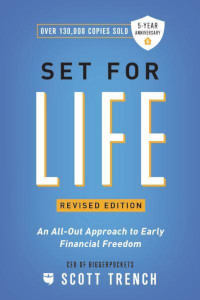
Set For Life by Scott Trench. An all-out approach to early financial freedom by the CEO of biggerpockets.
Set For Life by Scott Trench

In this book, Trench provides readers with a step-by-step guide to building wealth and securing their financial future. He covers topics such as budgeting, saving, investing, and managing debt, and he provides readers with practical tips and strategies for implementing these concepts in their own lives.

Achieving Financial Freedom with Scott Trench’s Set for Life

Understanding Your Financial Situation

The first step in achieving financial freedom, according to Trench, is to understand your current financial situation. This involves taking a close look at your income, expenses, debts, and assets. By understanding your current financial situation, you can better plan for the future and make informed decisions about how to allocate your resources.

An emergency fund is a critical component of financial stability, and Scott Strench’s book “Set for life” provides valuable insights into why and how to set up an emergency fund. Here are a few tips from Strench’s book on how to establish an effective emergency fund.

  1. Determine your emergency fund target: The first step in setting up an emergency fund is determining your target amount. A general rule of thumb is to aim for three to six months’ worth of living expenses. This will ensure that you have enough money to cover unexpected expenses, such as medical bills or job loss.
  2. Make it a priority: Setting up an emergency fund should be a priority. Make sure to allocate a portion of your income towards your emergency fund every month, and avoid dipping into it for non-emergency expenses.
  3. Make it easily accessible: An emergency fund should be easily accessible in case of an emergency. Consider setting up a separate savings account that is dedicated to your emergency fund.
  4. Automate contributions: Automating contributions to your emergency fund is a great way to ensure that you stay on track. Consider setting up automatic transfers from your checking account to your emergency fund every month.
  5. Consider high-yield savings options: Consider using a high-yield savings account to earn more interest on your emergency fund. This can help your money grow faster and make it easier to reach your target amount.

By following these tips, you can establish an effective emergency fund and achieve financial stability. An emergency fund is a safety net that can help you weather unexpected expenses and avoid going into debt. Whether you determine your emergency fund target, make it a priority, make it easily accessible, automate contributions, or consider high-yield savings options, there are many ways to set up an emergency fund and achieve financial security.

Budgeting for Financial Freedom

Once you have a good understanding of your financial situation, Trench recommends that you start creating a budget. A budget can help you track your spending and ensure that you are not overspending in any one area. By creating a budget, you can also identify areas where you can make cuts or adjust your spending to allocate more money towards your financial goals. Budgeting is a critical component of achieving financial stability, and Scott Strench’s book “Set for Life” offers valuable insights into how to create a budget that works for you. Here are a few tips from Strench’s book on how to budget effectively.

  1. Track your spending: The first step in creating a budget is to track your spending. This means recording every expense you make, no matter how small. By tracking your spending, you’ll get a better understanding of where your money is going, and you’ll be able to identify areas where you can cut back.
  2. Create a realistic budget: Once you’ve tracked your spending, it’s time to create a realistic budget. This means allocating your income to cover all of your expenses, including fixed costs such as housing, transportation, and food, as well as discretionary expenses such as entertainment and shopping.
  3. Prioritize your expenses: When creating a budget, it’s important to prioritize your expenses. Make sure to allocate enough money for essential expenses, such as housing, food, and transportation, before allocating funds for discretionary expenses.
  4. Be flexible: A budget is not a one-size-fits-all solution. Your budget should be flexible, and you should be willing to make adjustments as your needs change. If your income decreases, for example, you may need to cut back on discretionary expenses in order to make ends meet.
  5. Avoid debt: Debt is one of the biggest roadblocks to financial stability, and it’s important to avoid taking on unnecessary debt when creating a budget. Instead, focus on living below your means and saving as much money as possible.

By following these tips, you can create a budget that works for you and achieve financial stability. Budgeting can be challenging, but with a little effort and discipline, you can create a budget that helps you reach your financial goals. Whether you track your spending, create a realistic budget, prioritize your expenses, be flexible, or avoid debt, there are many ways to budget effectively and achieve financial stability.

Saving and Investing for the Future

Saving and investing are crucial components of achieving financial freedom, and Trench provides readers with comprehensive guidance on these topics. He emphasizes the importance of having an emergency fund and provides tips on how to save money effectively. He also provides guidance on different types of investments, including stocks, bonds, and real estate, and he discusses the benefits and drawbacks of each type of investment.

Build and Enjoy a Frugal Lifestyle

Building and enjoying a frugal lifestyle is a key concept discussed in Scott Trench’s book “Set for Life.” A frugal lifestyle involves living within your means, reducing expenses, and focusing on what truly matters in life. The goal of a frugal lifestyle is to attain financial independence and live a more fulfilling life without the stress of debt and financial worries. In this article, we will explore the principles of building and enjoying a frugal lifestyle as explained in Scott Trench’s book “Set for Life.”

  1. Embrace minimalism: A frugal lifestyle often involves embracing minimalism and letting go of material possessions that do not bring joy or serve a practical purpose. This can help reduce clutter, save money, and simplify your life.
  2. Track expenses: Keeping track of your expenses is key to understanding where your money is going and finding areas where you can cut back. Use budgeting tools, such as a spreadsheet or app, to keep track of your spending.
  3. Reduce expenses: Identify areas where you can reduce expenses, such as eating out less, cutting back on entertainment costs, or reducing transportation expenses. Every little bit adds up and can help you reach your financial goals faster.
  4. Prioritize experiences over things: Instead of spending money on material possessions, focus on experiences and memories that will last a lifetime. This can include traveling, trying new activities, or spending time with loved ones.
  5. Focus on financial goals: A frugal lifestyle is not just about reducing expenses, but also about achieving financial goals, such as paying off debt, building an emergency fund, or saving for retirement. Focus on your goals and make spending decisions that align with them.
  6. Cook at home: Eating at home is often much cheaper than eating out, and it can also be healthier. Cook meals at home and bring leftovers to work for lunch to save money and time.
  7. Buy quality over quantity: When making purchases, prioritize quality over quantity. Invest in durable goods that will last a long time, rather than buying cheaper items that will need to be replaced often.
  8. Shop sales and use coupons: Take advantage of sales and use coupons to save money on purchases. Do research and compare prices to get the best deal.
  9. Be mindful of energy usage: Reduce energy costs by being mindful of energy usage, such as turning off lights and unplugging electronics when not in use.
  10. Enjoy free activities: Take advantage of free activities in your community, such as parks, libraries, and community events. This can provide a fun and low-cost way to spend time with family and friends.
  11. Focus on financial literacy: Increase your financial literacy by reading books, taking classes, and seeking advice from financial experts. The more you know about personal finance, the better equipped you will be to make informed decisions.
  12. Surround yourself with like-minded people: Surrounding yourself with like-minded people who value frugality and financial independence can provide support, inspiration, and accountability.

Building and enjoying a frugal lifestyle can bring many benefits, including reduced stress, increased financial stability, and a simpler, more fulfilling life. By following the principles discussed in Scott Trench’s book “Set for Life,” you can make progress towards your financial goals and live a more fulfilling life. Remember that building a frugal lifestyle takes time and effort, but with patience and perseverance, the rewards are well worth it.

Cut On Commute Expenses

Commuting can be a significant expense, both in terms of time and money. According to Scott Strench’s book “Set for Life,” cutting down on commute expenses is an effective way to increase your savings and improve your financial stability. Here are a few tips from Strench’s book that can help you reduce your commuting costs.

  1. Consider alternative modes of transportation: One of the biggest expenses associated with commuting is the cost of driving. By using alternative modes of transportation, such as public transit, biking, or carpooling, you can significantly reduce your transportation costs. Additionally, using alternative modes of transportation can also be a more environmentally friendly option.
  2. Take advantage of tax benefits: If you use public transit or a bike for your commute, you may be eligible for tax benefits. The Commuter Benefit Law allows employees to use pre-tax dollars to pay for their commute expenses.
  3. Telecommuting: If your job allows it, consider working from home. Telecommuting eliminates the need to commute altogether, saving you both time and money.
  4. Buy a fuel-efficient vehicle: If you need to drive to work, consider buying a fuel-efficient vehicle. This will reduce the amount of money you spend on gas, maintenance, and other related expenses.
  5. Carpool: If you need to drive, consider carpooling with coworkers or friends. Not only will this reduce the cost of gas, but it can also help reduce your carbon footprint.

By following these tips, you can reduce your commuting expenses and improve your financial stability. Commuting can be a significant expense, but with a little planning, you can make it a manageable part of your budget. Whether you use alternative modes of transportation, take advantage of tax benefits, or carpool with friends, there are many ways to reduce your commuting costs and improve your financial stability.

Cut On Housing Expenses

Housing is often one of the largest expenses in a person’s budget. According to Scott Strench’s book “Set for Life,” cutting down on housing expenses can be an effective way to increase your savings and improve your financial stability. Here are a few tips from Strench’s book that can help you reduce your housing costs.

  1. Live below your means: One of the most effective ways to reduce housing costs is to live below your means. By choosing a smaller, more affordable home, you can reduce your monthly mortgage or rent payment. This will also help you build equity faster and reduce your debt burden.
  2. Rent instead of buy: If you’re not ready to buy a home, consider renting instead. Renting can be a more affordable option, and it eliminates the need to worry about maintenance and property taxes.
  3. Take advantage of roommate situations: If you’re single or have a partner who works outside the home, consider finding a roommate. Splitting housing costs with another person can significantly reduce your monthly expenses.
  4. Move to a more affordable area: If you’re looking to reduce housing costs, consider moving to a more affordable area. This may mean moving to a smaller town or a different region, but it can also mean moving to a more affordable neighborhood in your current city.
  5. Consider alternative housing options: If you’re not interested in traditional homeownership or renting, consider alternative housing options, such as a co-living arrangement or a tiny home. These options can be more affordable and provide a sense of community that you may not find in traditional housing arrangements.

By following these tips, you can reduce your housing expenses and improve your financial stability. Housing is a significant expense, but with a little planning, you can make it a manageable part of your budget. Whether you live below your means, rent instead of buy, take advantage of roommate situations, move to a more affordable area, or consider alternative housing options, there are many ways to reduce your housing costs and improve your financial stability. This echoes the house hacking trick.

Managing Debt and Building Wealth

Another key aspect of achieving financial freedom is managing debt and building wealth. Trench provides readers with practical tips and strategies for reducing and paying off debt, and he emphasizes the importance of avoiding high-interest debt and paying off credit card balances as soon as possible. He also provides advice on how to build wealth through investing, saving, and budgeting, and he discusses the importance of creating multiple streams of income.

In his book “Set for Life,” Scott Strench explains the concept of scalable income and how it can be used to achieve financial stability and independence. Scalable income refers to income that can grow as your work or investment grows, rather than being limited to a set salary or hourly wage. Here are a few tips from Strench’s book on how to build scalable income streams.

  1. Invest in yourself: One of the most important steps in building scalable income is investing in yourself. This may involve taking classes, acquiring new skills, or starting a side hustle. By investing in your personal and professional growth, you can increase your earning potential and create new opportunities for scalable income.
  2. Diversify your income streams: Diversifying your income streams is crucial for building scalable income. Instead of relying on a single source of income, consider multiple streams, such as freelance work, rental properties, or stock investments. This will help you to weather economic ups and downs and ensure a steady stream of income.
  3. Consider passive income: Passive income is income that requires little to no ongoing effort. Examples of passive income include rental properties, dividend stocks, or online businesses. Building a portfolio of passive income streams can help you achieve financial stability and independence.
  4. Automate your finances: Automating your finances is another important step in building scalable income. By setting up automatic savings and investment accounts, you can ensure that your money is working for you even when you’re not actively managing it.
  5. Be mindful of expenses: In order to build scalable income, it’s important to be mindful of your expenses. Avoid taking on debt, and focus on living below your means. This will help you to save more money and invest in opportunities that can generate scalable income.

By following these tips, you can build scalable income streams and achieve financial stability and independence. Scalable income is a powerful tool for securing your financial future, and with a little effort, you can use it to achieve your financial goals. Whether you invest in yourself, diversify your income streams, consider passive income, automate your finances, or live below your means, there are many ways to build scalable income and achieve financial independence.

Living a Fulfilling Life

While financial freedom is an important goal, Trench also stresses the importance of living a fulfilling life. He argues that financial freedom can provide the freedom and security needed to pursue other personal and professional goals, and he provides readers with tips on how to balance work and leisure, pursue their passions, and build strong relationships with loved ones.

Conclusion

“Set for Life” by Scott Trench is an excellent resource for anyone looking to achieve financial freedom and build a secure financial future. With its clear and concise approach to personal finance, practical and actionable advice, and emphasis on living a fulfilling life, this book is a must-read for anyone looking to take control of their finances and achieve their financial goals.