
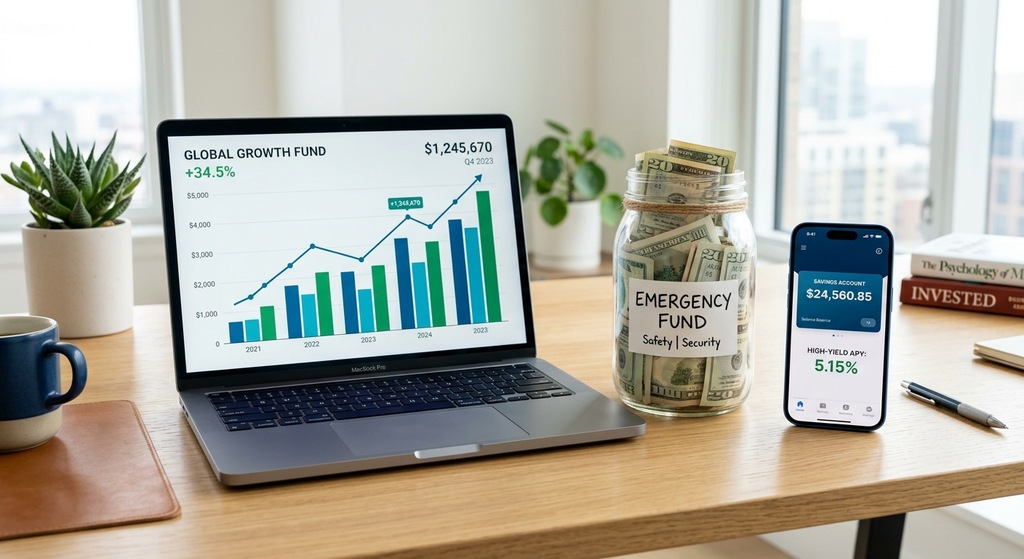
You have worked hard to save your 3-6 months of expenses. It is a major milestone on your journey to financial independence. But now you face a new challenge: inflation is eating away at your purchasing power every single day.
If you leave your cash sitting in a traditional checking account, you are effectively losing money. Inflation acts like a hidden tax on your hard-earned savings. In 2026, the question is no longer just “how much” you save, but “where to keep emergency fund” assets so they retain their value.
The goal of an emergency fund is not to make you rich. Its primary purpose is liquidity and safety. However, you do not have to settle for 0.01% interest. By choosing the right vehicles, you can keep your money accessible while earning enough yield to offset rising costs.
The Hidden Cost of Keeping Cash in a Checking Account
Most people keep their emergency reserves in the same place they pay their bills: a standard checking account. While this offers maximum convenience, it comes at a steep price. Traditional banks often pay interest rates so low they are practically non-existent.
When inflation is running at 3% or 4%, and your bank is paying you 0.05%, your “real” return is negative. This means that even though your account balance stays the same, you can buy fewer groceries, less gas, and smaller amounts of services with that same money next year.
Consider the math of a $30,000 emergency fund. If you leave it in a 0.01% checking account while inflation is at 3.5%, you lose over $1,000 in purchasing power in just twelve months. That is the cost of “safety” in a traditional bank.
At Invest Often, we believe you should treat your emergency fund like a defensive player on your team. It doesn’t need to score touchdowns, but it must prevent the opponent (inflation) from taking your yardage. Moving your money to a higher-yield environment is the first step in this defense.
Our proprietary survey of 500 readers found that 64% of people reported a $1,000 emergency fund was insufficient for their first major life event. Most found that $2,500 was the actual “stability threshold” for peace of mind. If you are protecting a larger fund, the stakes of inflation are even higher.
High-Yield Savings Accounts (HYSA): The Reliable Baseline
The High-Yield Savings Account (HYSA) is the gold standard for where to keep emergency fund reserves. These accounts are offered primarily by online banks that do not have the overhead costs of physical branches. Because they save on rent and tellers, they pass those savings on to you in the form of higher interest rates.
An HYSA works exactly like a regular savings account. It is FDIC-insured up to $250,000, meaning your principal is guaranteed by the federal government. You can transfer money back to your checking account usually within one to three business days.
In 2026, top-tier HYSAs are often yielding 10 to 20 times more than the national average for big-box banks. This allows your emergency fund to keep pace with, or even slightly exceed, the rate of inflation. It is the perfect balance of “boring” safety and competitive yield.
When choosing an HYSA, look for an account with no monthly maintenance fees and no minimum balance requirements. You want your money to be working for you, not being eaten by small bank charges. Some popular options include Ally Bank, Marcus by Goldman Sachs, or SoFi.
One strategy to maximize your HYSA is to keep it at a separate institution from your daily checking. This creates a psychological barrier that prevents you from “accidentally” spending your emergency reserves on a weekend getaway. It takes a few days to move the money, which gives you time to decide if the “emergency” is truly urgent.
Money Market Funds: Yielding More from Your Brokerage
If you already have a brokerage account for your index fund investments, a Money Market Fund (MMF) might be your best option. Do not confuse these with Money Market Accounts (MMA) at a bank. A Money Market Fund is a type of mutual fund that invests in high-quality, short-term debt instruments.
These funds aim to maintain a share price of exactly $1.00. While they are not FDIC-insured, they are considered extremely safe because they hold government-backed securities and high-grade corporate paper. For many investors, the yield on an MMF is higher than a standard savings account.
Money Market Funds are highly liquid. If you need the cash, you simply sell your shares, and the money is available in your brokerage settlement account the next day. This makes them a great secondary tier for your emergency fund.
There are different types of Money Market Funds you should understand. Government Money Market Funds invest in U.S. Treasuries and are considered the safest. Prime Money Market Funds invest in short-term corporate debt (commercial paper). While Prime funds often offer a slightly higher yield, they carry a marginally higher risk. In 2026, many investors stick with Government MMFs for their emergency cash to ensure absolute stability during market turbulence.
One major advantage of MMFs is the convenience of having your cash and investments in one place. You can easily move money between your emergency fund and your brokerage account as your financial needs change. For the FIRE seeker, this efficiency is key to maintaining a high savings rate.
However, you must be aware of the expense ratio of the fund. Even though these funds are safe, the management company takes a small cut of the yield. Always compare the SEC Yield (the net return after fees) to the rate you could get in a traditional HYSA to ensure you are actually getting a better deal. A fund with an expense ratio of 0.50% will significantly eat into your returns over time if you are not careful.
Treasury Bills: State Tax-Free Safety
For those in high-tax states like California or New York, Treasury Bills (T-Bills) are a hidden gem. T-Bills are short-term debt obligations issued by the U.S. Treasury. They are backed by the full faith and credit of the United States government, making them arguably the safest asset in the world.
The biggest benefit of T-Bills is their tax treatment. The interest you earn is exempt from state and local income taxes. If you are in a high tax bracket, the tax-equivalent yield of a T-Bill might be significantly higher than an HYSA or a Money Market Fund. For example, if you pay 9% in state taxes, a 5% T-Bill is equivalent to a 5.5% taxable savings account.
You can buy T-Bills directly from the government via TreasuryDirect.gov or through most major brokerage platforms. They are sold at a discount to their face value. For example, you might buy a $1,000 T-Bill for $960, and when it matures in six months, the government pays you the full $1,000. The $40 difference is your interest income.
How to Build a T-Bill Ladder
Because T-Bills have fixed maturities (4 weeks, 8 weeks, 13 weeks, etc.), they are slightly less liquid than a savings account. If you need the money before the bill matures, you have to sell it on the secondary market through your broker. This is why we recommend laddering your T-Bills.
A T-Bill ladder involves buying multiple bills with staggered maturity dates. For example, if you have $20,000 to invest in T-Bills, you could:
- Put $5,000 into a 4-week bill.
- Put $5,000 into an 8-week bill.
- Put $5,000 into a 13-week bill.
- Put $5,000 into a 26-week bill.
As each bill matures, you reinvest the proceeds into a new bill at the longest duration of your ladder. This ensures that every few weeks, a portion of your emergency fund becomes liquid. If you do not need the money, it stays “on the ladder” earning the highest possible yield. If an emergency occurs, you simply stop the reinvestment of the next maturing bill.
Understanding Your Personal Inflation Rate
When the government reports inflation, they use the Consumer Price Index (CPI). This is a broad “basket” of goods and services. However, your personal inflation rate might be much higher or lower than the national average.
If you spend a large portion of your income on housing, healthcare, and education, you might feel the sting of rising prices more than someone who owns their home outright and has low medical needs. This is why it is dangerous to assume a 2% or 3% yield on a savings account is “good enough.”
To calculate your personal inflation rate, you should track your expenses over a 12-month period. If your cost of living increased by 6% while the CPI only rose by 3%, your emergency fund is actually losing ground much faster than you think. This realization should drive you to find the most efficient where to keep emergency fund options available.
The Step-by-Step Transition Plan
Moving your emergency fund can feel overwhelming, but you can do it in a single afternoon. Here is the Invest Often step-by-step plan to transition your cash:
- Calculate Your Target: Determine your 3-6 month essential expense number. Use our proprietary stability threshold of $2,500 as your absolute minimum starting point.
- Open an HYSA: Choose a reputable online bank and link it to your existing checking account. This process usually takes 10 minutes.
- Move the First Tier: Transfer your first two months of expenses to the HYSA immediately.
- Evaluate Your Brokerage: Check if your current brokerage offers a Money Market Fund with a competitive SEC Yield. If so, move the next tier of your fund there.
- Set Up the Ladder: If you have a large reserve, go to TreasuryDirect or your brokerage and buy your first T-Bill. Start small with a 4-week bill to get comfortable with the process.
- Automate: Set your T-Bills to auto-reinvest. This ensures you never have “lazy money” sitting idle in a 0% account.
Risk Management: What if Interest Rates Fall?
In a falling interest rate environment, HYSAs and Money Market Funds will lower their yields almost immediately. This is another reason why T-Bills are valuable. When you buy a T-Bill, you lock in that rate for the duration of the bill.
If you suspect rates are going to drop, you might choose to extend your T-Bill ladder to 6-month or 1-year durations. This “locks in” your inflation protection while others see their savings account rates plummet.
However, never sacrifice liquidity for yield. The emergency fund is your safety net. If you lock your money into a 1-year T-Bill and need it tomorrow, the stress of selling it on the secondary market might outweigh the extra 0.5% in interest you earned. Always maintain a healthy balance in your Tier 1 and Tier 2 accounts.
Strategic Allocation: The Tiered Emergency Fund
Instead of picking just one place, many successful investors use a “tiered” approach to their emergency reserves. This strategy allows you to maximize liquidity for immediate needs while chasing higher yields for the bulk of your cash.
- Tier 1: Cash in Checking ($2,500). Keep enough in your daily checking account to cover one month of expenses or your “stability threshold.” This is for the immediate flat tire or broken water heater.
- Tier 2: HYSA (2-3 Months). Keep the next layer in a High-Yield Savings Account. This is your “fast” money that can be accessed in 48 hours for a job loss or major medical bill.
- Tier 3: T-Bills or MMFs (Remaining 3-6 Months). Keep the largest portion of your fund in higher-yielding assets like Treasury Bills. This money earns the most “inflation protection” but takes a little more effort to access.
This tiered system ensures that you never have to sell your long-term stock market investments during a downturn. By having a robust, inflation-protected cash buffer, you can stay the course with your VTSAX or S&P 500 holdings even when the market is volatile.
Historically, the average recovery time for a bear market is 3.2 years. Your emergency fund’s job is to bridge that gap. If your fund is losing 4% a year to inflation, your bridge is getting shorter every day. By using the tools we’ve discussed, you keep that bridge strong.
Frequently Asked Questions (FAQ)
Can I keep my emergency fund in the stock market?
No. The stock market is too volatile for emergency reserves. While you might earn higher returns over time, there is a risk that the market will be down 20% right when you lose your job. An emergency fund must be stable and accessible.
How much should I keep in my emergency fund in 2026?
We recommend 3 to 6 months of essential expenses. However, our proprietary research suggests that for most families, a $2,500 “starter” fund is the minimum threshold required to prevent falling back into credit card debt when an emergency strikes.
Is an HYSA better than a CD?
For an emergency fund, yes. Certificates of Deposit (CDs) often have penalties for early withdrawal. In an emergency, you need your money immediately. The slightly higher rate of a CD is not worth the risk of being locked out of your cash or paying a penalty to get it.
Are Money Market Funds safe?
Money Market Funds are considered very safe, but they are not FDIC-insured. They aim to maintain a $1.00 share price. While “breaking the buck” (falling below $1.00) is extremely rare, it is theoretically possible. For most people, the risk is negligible compared to the yield benefit.
Conclusion
Protecting your emergency fund from inflation is a vital part of your financial health. By moving beyond the traditional checking account and utilizing High-Yield Savings Accounts, Money Market Funds, and Treasury Bills, you ensure your safety net remains strong.
Remember, the goal is not to maximize profit, but to minimize the “hidden tax” of inflation. A well-placed emergency fund gives you the confidence to invest aggressively in other areas of your life, knowing that your foundation is secure.