Categories
Financial Literacy Investing

What Are The Main Investment Types?

We’ll try to list the main investment types out there, how they function, i.e. how do you make money from them and we’ll try to classify how passive they are and the usual expected volatility.

What Are The Main Investment Types?

1. Real Estate

There are several ways to invest in real estate, from land acquisition, land development, single family rentals, multi family rentals, office rentals, industrial rentals. While there are a lot more hybrid investment types from house hacking to vacation rentals, we’ll only go through the main investment types in this introductory post.

1.1 Single Family Rentals

This is probably the most straightforward investment type in the real estate space: acquiring single family homes and rent them out. The business is simple: rent the home and maintain it in habitable condition for the customer.

The owner of the rental also may also profit down the road by selling the property for a profit if it appreciates.

1.2 Multi Family Rentals

Similar to single family rentals, but the asset is in general an apartment building. Duplexes and triplexes, smaller buildings, also qualify as multi family.

1.3 Land Acquisition

This is usually an appreciation play, where one would simply acquire land hoping to sell later in time, for a profit, if the land appreciates in value over time.

There’s one main exception regarding agricultural lending, where one can lend its land to a farmer to exploit the land. The owner of the land receives a rent and in exchange the farmer can exploit the land growing crops or farming livestock.

1.4 Land Development

Land development consist in acquiring raw land and developing it, usually bringing electricity, water and sewer to sell it to a real estate builder to then build and sell buildings, often multi family or single family homes.

1.5 Office Rentals

This is similar to multi family rentals, in the sense that this involves usually bigger buildings, however they’re usually leased to companies or specialized professionals.

1.6 Industrial Rentals

This is similar to office rentals, but concerns industrial buildings usually leased to companies. In this categories we usually have warehouses or industrial buildings able to house machinery.

2. Stocks

Stocks are usually fractions of a company traded on an exchange.  By buying the stock, you buy a fraction of said company.

2.1 Regular Stocks

By buying the stock, you expect the company to do well and have its share price increase to later sell it for a profit.

2.2 ETFs

ETFs or Exchange Traded Fund are usually funds that invest in several companies/stocks or track some indexes. It allows you to own a pool of investments without the hassle of having to buy every single one of them individually.

Similar to stocks, you’d buy the ETF expecting it to go up in value to sell for a profit.

2.3 Dividend Stocks

Dividend stocks are stocks that pay a dividend, sometimes monthly, but usually quarterly, as long as you’re holding the stocks. These stocks are usually from more established companies, with proven business models, where the growth of the stock usually lower but compensate for it with its dividend.

Dividend are taxed differently than capital gains from selling stocks for a profit and can be interesting in that regards.

Also several dividend companies tend to increase their dividend over time. Dividend aristocrats are dividend companies that have increased their dividend for at least 25 years.

2.4 REITs

REITs or Real Estate Investment Trust are companies that invest primarily in you guessed it, real estate. To qualify as a REIT must have at least 75% of its income derived from real estate and it must distribute at least 90% of its taxable income as dividend to its shareholders.

REITs income is usually taxed as income, unlike dividends and based on your tax bracket, it may be advantageous to hold them in tax preferred accounts such as a 401k or an IRA.

3. Bonds

Bonds are loan to a government (government bonds) or to a company (corporate bonds) for a certain period of time (maturity)and you receive interest (the coupon) , until the loans matures at which point you receive the principal payment.

4. Leveraged Financial Instruments

4.1 Options

Options, commonly on stocks, but can also apply against other financial instruments, are just that: option (not obligation) to buy (call option) or sell (put option) at a given price (strike price) until a certain time, the expiration date.

These investments are usually more volatile and riskier, because of the leverage builtin into the contract.

4.2 Forex

This is the currency market, where ones can profit from the gain of a currency against another. While usually reserved for more advanced investors, the concept is often eye opening that whatever you own that changes in value is a paired trade. When the USD/JPY forex pair trade goes up it means the US dollar goes up against the Japanese yen. When your home goes up in value, it means your home value goes up against the dollar. At which point you want to ask, is the house gaining in value or is the dollar losing in value?

Forex symbols are usually traded with leverage which can increase the risk if not managed carefully.

4.3 Futures

Futures are contract, usually on commodities but also on stock indexes and currencies. The contract establishes the price of an amount of a commodity at a certain date, e.g. The June 2020 Gold contract, at $1583, establishes the price of an ounce of gold by June 2020.

The market allows producers of such commodities to lock in a price for their production, while speculators, often blamed for commodities volatility allow the market to exist in the first place.

While not perfect, it should be noted that the existence of the market allow producers to hedge their production and many producers would not be in business without the existence of the futures market.

Futures , like the Forex, are usually traded with leverage which can increase the risk if not managed carefully.

5. Alternative Investments

This involves structured financial products in various area, such as art, real estate, marine, legal… It often involve lending money to a third party using various assets from the third party as collateral.

It’s usually reserved to accredited investors, i.e. investors earning more than $200,000 annually if single ($300,000 if married) or have more than $1,000,000  in assets excluding the primary residence. Or institutional investors like investment banks, pension funds and so on.

6. Private Equity

Private equity is generally speaking part of the alternative investments class, but probably deserves a note of its own. Like for alternative investments, these investments come mainly from accredited investors or institutional investors. There are 2 main segments in private equity: one for early stage companies or startups, one for later stage companies and distressed companies.

6.1 Early stage companies or startups

That’s usually where venture capital and angel investors come in. They will pool money or invest their own money to help develop early stage companies, usually in the hope the resell it at a higher price to a bigger company or take it to the public market, where they can exit their position.

The game in startups investing is that most of your investments will go to zero, but the few who survive will make a disproportionate amount of money.

If you want to put some rough numbers, successful startups investors, often see 90% of their investments go to zero. 9% percent of their investments get a 10-50x returns. And 1% turn into a 100-2000x returns and sometimes more.

The downside is that there’s usually no liquidity, so it’s very hard to liquidate your holdings and it’s usually a long game. It will take usually more than 5 and often around 10 years for those early companies to mature to the point where you can expect those enormous gains.

6.2 Distressed companies

Another side of private equity is to invest in failing or distressed companies. Investors usually buy the debt of a company at a steep discount and will try to turn the management around and eventually turn it into a profitable company again, so they can eventually collect the debt repayment.

If that ideal scenario fails and the company is forced into bankruptcy, investors will try to recoup some money during the bankruptcy process.

7. Institutional Investments

This are types of investments reserved for institutions (e.g. CDS), usually due to the amount required to participate in such investments which can range from several hundreds millions of dollar or billions of dollars and sometimes require special licenses to be allowed to participate into such investments. We won’t discuss much about these but it’s good to know that they exist because they can have some influence into other types of investments accessible to the general public.

Conclusion

We’ve presented most of the common investment classes. As far as building a passive income portfolio, we’ll talk more about rental real estate and stocks. We’ll also touch upon alternative investments and also discuss some opportunities with leveraged financial instruments when they arise.

Categories
Financial Literacy

The Fastest Way To Pay Down Debt

If you have several outstanding loans, what’s the fastest way to pay them down? How should you prioritize which loan to pay down first?

The most efficient way to pay down existing debt burden is better known as the debt avalanche method.

It goes like this:

  1. Make an inventory of all the debt you have and their associated interest rate.
  2. Keep paying the minimum payment on all debt to avoid any fees and deteriorate your credit score.
  3. Focus on one loan at a time and make an extra payment on the loan that has the highest interest rate. Keep doing it until the loan is paid.
  4. Congratulations, you now have one loan paid off. Move to the next highest interest rate loan and use the extra cash freed from the minimum payment of the loan you just paid to pay this second loan even faster.
  5. Rinse, repeat, until you do not have any more outstanding debt, paying each loan faster by redirecting the extra cash from each paid off loan towards paying the next one.

This strategy minimizes the amount of interest you pay by targeting the loans with the highest interest rates first.

Some argue that in the battle towards paying off debt, the psychological aspect may be more important as it is often a marathon more than a sprint. And therefore seeking early sign of encouragement may go a long way to stay on the path of debt freedom.

In that regards the debt snowball approach is sometimes considered. The principle is similar to the debt avalanche method but instead of focusing on the loan with the highest interest rate, you’d focus on the loan with the smallest balance. So you more quickly scratch a loan off your list as an early encouragement.

However Mr. Honu is way too cartesian to allow extra interest payment to run and would focus on the debt avalanche method instead. But that’s just me. The debt snowball can be a decent alternative and is certainly better than letting your debt run away.

There are more resources on the debt avalanche and the debt snowball on the internet.

Categories
Financial Literacy

Is Debt Bad and Should It Be Avoided at All Costs?

If you have some debt, should you pay it first or should you try to invest your way out of it? Is debt good or bad?

Generally speaking and as noticed in the “defining asset vs liability” post, debt is not inherently good or bad, it’s mostly about how it’s used. At the end of the day, debt is just leverage and you pay a premium to use that leverage in the form of interests.

Therefore, from an economic perspective, it usually only makes sense to use this leverage if the benefit of this leverage outweighs the cost of the premium. More simply said, if you borrow money at 5% per year and you’re pretty sure you’ll make a 10% or 20% return on that borrowed money it’s certainly worth it. However if the returns were only 3%, the cost of the debt would be higher than what you’d earn and it would probably not make sense from an economic standpoint to contract such loan.

So in the end, using debt to acquire cash flow performing assets is definitely worth it if the returns are higher than the cost of servicing the debt. But otherwise it should be avoided. Using debt for regular consumption is probably the worse type of debt one can contract, since the returns on consumption items are usually 0%: that new appliance or that fancy dinner will not make you any money.

A note on education: the current outstanding student loan debt in the US is now over $1.6 trillion. And many people are stuck in a job that does not allow them to service their student debt burden. Worse, as of January 2020, student debt is not dischargeable in bankruptcy and you may be stuck with your student debt for life. So for any student looking for a student loan, it’s probably wise to check what’s the salary one can expect out of college to assess how much debt is reasonable.

There are several websites to check how much one can expect for a given job:

Having, let’s say, $50,000 of debt out of Med school to be a physician is probably reasonable, ditto with a Computer Science degree to be employed as a software engineer (at least in early 2020), as these jobs tend to earn at least six figures out of college, but it is not the case for many other degrees.

It may all sounds like common sense, but it’s important to absorb and never forget the fundamental economic mechanics of debt, because it’s easy to get tempted by a fancy new appliance, house or college degree that could put an enormous drag on your finances and delay your financial freedom by several years if not forever.

But what if you already have debt? Should you pay it first or invest your way out of it? Well, every investment carries some risk and the money invested can be completely lost. On the other hand, the debt you pay down, is a guaranteed balance payment you won’t have to service anymore. Therefore, it’s usually more advantageous to pay down existing consumer/student loan debt.

But debt at the end of the day is leverage, and leverage carries risk. And carrying risk over an extended period of time is something to be dealt with carefully.

So, how should you go about paying it off? Have a look at the Fastest Way To Pay Down Debt.

Categories
Financial Literacy

The Power Of Compounding

If you have $10,000 and you earn a 7% interest per year on it, you’ll end up with $10,700 at the end of the year:

10,000 + 10,000 x 7/100 = 10,700

And if you reinvest the profits, these $10,700 at 7% will become $11,449 the next year, and so on and so forth. You get the idea.

And while it does not seem like much it quickly adds up over time. Here is a chart of $10,000 at 7% compounded 50 times.

$10,000 with a 7% return

Now you may say that $280,000 is still not much over 50 years. But keep it mind, that it’s just money growing: you didn’t spend any time or any effort yet, it’s just $10,000 that you watched grow.

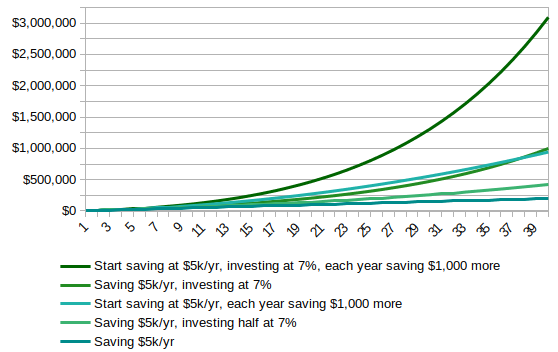
Now imagine that you’re able to save $5,000 a year and you invest them.

$10,000 with a 7% return, saving another $5,000

You’ll now cross the 1 million dollars mark after 40 years and you’ll get over 2 million dollars after 50 years.

And what if you’re able to save $10,000 a year?

$10,000 with a 7% return, saving another $10,000

You’ll cross the 1 million dollars mark after 31 years, and over 4 million dollars after 50 years.

Now these charts look the same but the scale is very different, when compared to one another:

And that’s how people get rich. It’s not by earning a higher salary which has barely changed for the average US worker in past 50 years, but by investing and reinvesting the profits, also known as compounding.

That fantastic power is unfortunately one of the most underappreciated and as Dr. Albert A. Bartlett puts it, “The greatest shortcoming of the human race is our inability to understand the exponential function“.

Now, the 7% growth rate is not completely innocent. It’s give or take, the average growth rate of the stock market in the past 100 years or so and we’ll get to that in another post.

To have a better grasp of the power and the sometimes dramatic implications of an exponential growth rate, I highly recommend the exponential growth arithmetic lecture from Dr. Albert A. Bartlett.

Who said education was expensive? Like most things in life, the best ones are often free. 😜

As a closing note, let’s be honest, saving $10,000 a year on a minimum wage will be close to impossible, unless you live with your parents. It will probably take at least a $50,000 income to be able to comfortably save $10,000 a year, depending upon the cost of living in your area, the number of dependents you have and your spending habits. And yes it represents a 20% saving rate which may seem high for some, but if you’re on a quest towards financial independence this is the minimum target you’d want to aim for. More on this to come soon.

Categories
Financial Literacy

Defining Asset vs Liability

Money is just another problem that needs to be solved. And to understand a problem it is critical to define it properly. Albert Einstein famously said: “If I had an hour to solve a problem I’d spend 55 minutes thinking about the problem and five minutes thinking about solutions.

And at the core of every problem definition lies the vocabulary and the true meaning of words. One of the greatest tragedy in modern age is not being able to properly define asset and liability.

So let’s keep this simple:

  • an Asset puts money in your pocket
  • a Liability takes money out of your pocket

Now if you’ve ever applied for a loan to buy a home, you may have stumbled upon a banker lauding how great of an asset your home is. Spoiler alert: it’s not. Or more precisely not for you.

Let me explain, to enjoy your home you’ll probably have to pay your mortgage, which takes money out of your pocket. You also have to pay property taxes which also takes money out of your pocket. You’ll need a home insurance, which again takes money out of your pocket. You’ll also need to cover expenses associated with maintaining your home, which yet again takes money out of you pocket. How much money does your home put in your pocket? $0. So from your perspective, your home is a liability not an asset.

Now looking at it from your banker’s perspective, the mortgage interests you pay on your loan brings money in your banker’s pocket. Therefore from your banker’s point of view, your home is an asset.

And with this comes an important corollary around assets and liabilities: the nature of a given resource usually does not define whether it is an asset or not. Instead the usage of such resource defines whether it’s an asset or not.

As seen with your home: it is a liability for you, but the exact same home is an asset for your banker.

Similarly if you own a rental property, which is just another home, and you make a profit after paying your mortgage and the associated expenses, then the rental property is an asset, because it puts money in your pocket.

Note that by integrating an investment component to your housing, you can limit or even sometimes eliminate the liability. And since the housing cost is usually the biggest household income for most people it’s well worth taking a hard look at it. See what house hacking can do for you.