
Categories
Stock Market Investing

Discover the Secrets to Successful Index Fund Investing

In today’s dynamic and complex financial landscape, investors are constantly seeking ways to maximize their returns while minimizing risk. One popular investment strategy that has gained significant attention is index fund investing. Index funds offer a passive approach to investing, providing broad market exposure and diversification. This article will guide you through the art of index fund investing and equip you with strategies for achieving success in this field.

Discover the Secrets to Successful Index Fund Investing

Understanding Index Funds

What are Index Funds?

Index funds are a type of mutual fund or exchange-traded fund (ETF) designed to track the performance of a specific market index, such as the S&P 500 or the Nasdaq Composite. These funds aim to replicate the returns of the index they are tied to, providing investors with exposure to a broad range of securities within that index.

secret

Benefits of Index Fund Investing

Index fund investing offers several advantages over actively managed funds. These include lower fees, broad market diversification, and the potential for consistent long-term returns. By mirroring the performance of a specific index, index funds remove the need for active stock selection and market timing, making them an attractive option for both novice and experienced investors.

Choosing the Right Index Fund

Types of Index Funds

Index funds are available for various asset classes, including stocks, bonds, and commodities. Some funds may focus on specific sectors or regions, while others provide exposure to the entire market. It’s crucial to understand the different types of index funds available and choose the ones that align with your investment goals and risk tolerance.

Evaluating Index Funds

When evaluating index funds, it’s essential to consider factors such as expense ratios, tracking error, and the fund’s history of performance. Additionally, examining the fund’s holdings, turnover rate, and fund manager’s expertise can provide valuable insights into the fund’s quality and potential returns.

Building a Diversified Portfolio

Asset Allocation

Building a well-diversified portfolio is crucial for long-term investment success. Allocating your investments across different asset classes, such as stocks, bonds, and real estate, can help mitigate risk and maximize potential returns. Determine your risk tolerance and investment objectives to create an asset allocation strategy that suits your needs.

Rebalancing Your Portfolio

Regularly reviewing and rebalancing your portfolio ensures that your investments remain aligned with your asset allocation goals. Rebalancing involves selling overperforming assets and buying underperforming ones to maintain the desired portfolio mix. This strategy helps manage risk and ensures that your investments stay on track.

Minimizing Costs and Expenses

Expense Ratios

Index funds are known for their low expense ratios compared to actively managed funds. An expense ratio represents the percentage of a fund’s assets used to cover operating expenses. By choosing index funds with low expense ratios, investors can minimize costs and retain a more significant portion of their investment returns.

Avoiding Load Fees

Load fees are sales charges or commissions applied to certain mutual funds. To reduce costs, investors should consider investing in no-load index funds that do not charge these fees. Avoiding load fees allows you to invest your money more efficiently and potentially generate higher long-term returns.

Long-Term Investing and Patience

The Power of Compounding

Index fund investing is ideally suited for long-term investors. The power of compounding enables investors to earn returns on both their initial investment and the accumulated returns over time. By staying invested in index funds for the long haul, you can harness the compounding effect and potentially grow your wealth significantly.

Riding Out Market Volatility

Stock markets are subject to volatility and short-term fluctuations. However, index fund investors can take advantage of the market’s long-term upward trend. Rather than reacting to short-term market movements, staying the course and remaining invested can help ride out market volatility and capture long-term market gains.

Monitoring and Reviewing Your Investments

Regular Portfolio Checkups

Regularly monitoring your index fund investments is essential to ensure they remain aligned with your financial goals. Conduct periodic portfolio checkups to assess the performance of your funds, review any changes in the market, and make adjustments if necessary. This proactive approach helps you stay informed and take timely action when required.

Adjusting Your Strategy

As your financial situation and goals evolve, it’s crucial to adjust your index fund investing strategy accordingly. Whether it’s modifying your asset allocation or exploring different types of index funds, being flexible and adaptable can optimize your investment outcomes over time.

Tax Efficiency Strategies

Understanding Capital Gains

Index fund investors should be aware of the tax implications of their investments. When you sell index fund shares at a profit, you may be subject to capital gains taxes. Understanding how capital gains taxes work and implementing tax-efficient strategies, such as holding investments for more extended periods or utilizing tax-advantaged accounts, can help minimize your tax burden.

Tax-Loss Harvesting

Tax-loss harvesting involves selling investments that have experienced losses to offset capital gains or reduce taxable income. Index fund investors can utilize this strategy during periods of market downturns to generate tax benefits. Consult with a tax professional to understand the rules and regulations surrounding tax-loss harvesting.

Emotions and Behavioral Biases

Avoiding Impulsive Decisions

Investing in index funds requires discipline and a long-term perspective. Emotions, such as fear and greed, can lead to impulsive decisions that may harm your investment performance. By maintaining a rational mindset, avoiding emotional biases, and adhering to your investment plan, you can overcome behavioral pitfalls and stay on track.

Staying Disciplined

Consistency and discipline are key to successfully mastering the art of index fund investing. Stick to your investment strategy, avoid chasing short-term market trends, and resist the temptation to make frequent changes to your portfolio. By staying disciplined and focused on your long-term goals, you increase your chances of achieving sustainable investment success.

Advantages of Dollar-Cost Averaging

Spreading Investment Risk

Dollar-cost averaging is a strategy that involves investing a fixed amount of money at regular intervals, regardless of market conditions. This approach allows you to buy more shares when prices are low and fewer shares when prices are high. By spreading your investments over time, you reduce the impact of market volatility and potentially mitigate the risk of making large investments at unfavorable prices.

Taking Advantage of Market Fluctuations

Dollar-cost averaging enables you to take advantage of market fluctuations and volatility. Instead of trying to time the market and make large lump-sum investments, this strategy allows you to invest consistently over the long term. By doing so, you buy more shares when prices are low, effectively lowering your average cost per share and potentially increasing your overall returns.

The Role of Professional Advice

Consulting with Financial Advisors

While index fund investing is a passive approach, seeking professional advice can still be beneficial. Financial advisors can help you assess your financial goals, determine the appropriate asset allocation, and provide guidance on selecting the right index funds. They can also provide ongoing support, monitor your investments, and help you navigate complex financial situations.

DIY vs. Professional Management

Deciding whether to manage your index fund investments yourself or seek professional management depends on your knowledge, expertise, and available time. While some investors prefer the hands-on approach of do-it-yourself investing, others may opt for professional management to ensure their investments align with their goals and to leverage the expertise of experienced professionals. Consider your comfort level, investment objectives, and resources when deciding which approach is right for you.

Conclusion

Mastering the art of index fund investing requires a combination of knowledge, discipline, and a long-term perspective. By understanding the fundamentals of index funds, choosing the right funds, building a diversified portfolio, minimizing costs, and staying disciplined, you can position yourself for investment success. Remember to monitor and review your investments regularly, employ tax-efficient strategies, manage your emotions, and consider seeking professional advice when needed. With dedication and patience, you can harness the power of index funds to achieve your financial goals.

Frequently Asked Questions (FAQs)

FAQ 1: Are index funds suitable for all investors?

Yes, index funds are suitable for a wide range of investors. Their low costs, diversification benefits, and long-term focus make them an attractive investment option for beginners and experienced investors alike.

FAQ 2: How do index funds compare to actively managed funds?

Index funds passively track specific market indexes, aiming to replicate their performance. In contrast, actively managed funds rely on fund managers’ expertise to select and manage investments. While active funds offer the potential for out-performance, they often come with higher fees and may struggle to consistently beat the market.

FAQ 3: Can I invest in index funds through my retirement account?

Yes, many retirement account options, such as 401(k)s and IRAs, offer index funds as investment choices. Investing in index funds through your retirement account can provide tax advantages and contribute to long-term wealth accumulation.

FAQ 4: What is the minimum investment required for index funds?

The minimum investment required for index funds can vary depending on the fund provider. Some index funds have low minimum investment requirements, while others may have higher thresholds. It’s essential to research different fund options and choose the one that aligns with your investment budget.

FAQ 5: Do index funds pay dividends?

Yes, index funds can pay dividends. The specific dividend distribution and frequency vary depending on the underlying securities held by the index fund. Dividends received from index funds can provide investors with additional income or the option to reinvest them for long-term growth.
Categories
Stock Market Investing

The Ultimate Beginner’s Guide to Index Fund Investing

In the world of investing, index funds have gained significant popularity among both seasoned investors and beginners. This guide aims to provide a comprehensive understanding of index fund investing and its benefits for beginners.

The Ultimate Beginner’s Guide to Index Fund Investing

Why Choose Index Fund Investing?

Index fund investing offers numerous advantages that make it an attractive option for beginners. Unlike actively managed funds, index funds aim to replicate the performance of a specific market index, such as the S&P 500. This approach provides diversification, low costs, and consistent performance, making it an excellent choice for beginners.

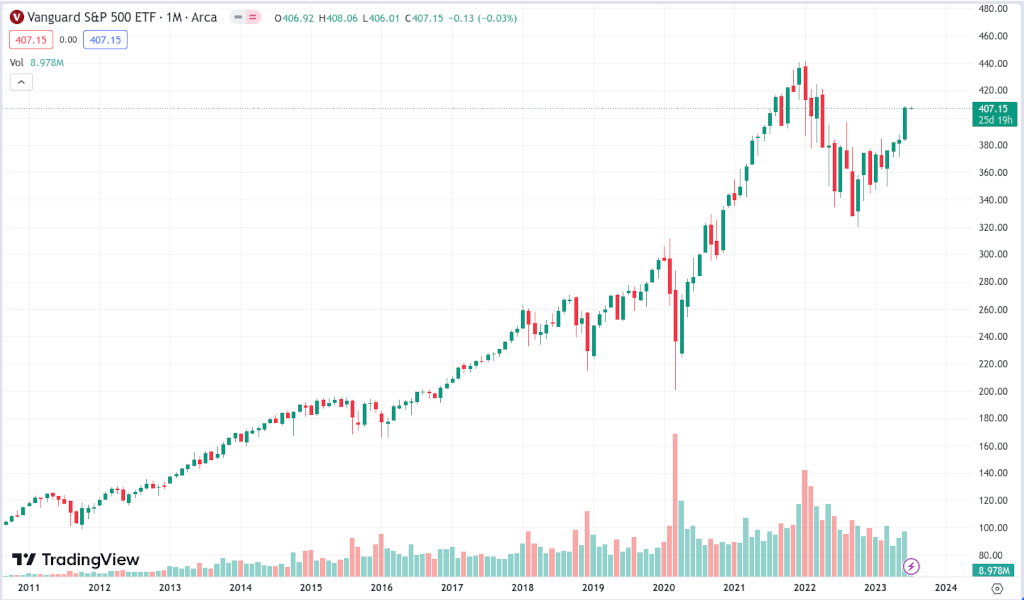
S&P 500 Chart

How Do Index Funds Work?

Index funds are passively managed funds that aim to match the performance of a particular market index. Instead of relying on fund managers to select individual stocks, index funds hold a diversified portfolio of securities that mimic the index’s composition. By doing so, they provide investors with broad market exposure and eliminate the need for constant monitoring and active trading.

Benefits of Index Fund Investing

Diversification

Index funds offer instant diversification by investing in a broad range of securities within a specific index. This diversification helps mitigate risk because even if some individual stocks perform poorly, others may offset those losses.

Low Costs

Compared to actively managed funds, index funds have significantly lower expense ratios. Since they aim to replicate the performance of an index rather than outperform it, they require less research and have lower transaction costs. This cost-efficiency benefits investors in the long run by reducing fees and increasing overall returns.

Passive Investing

Index fund investing follows a passive approach, which means investors do not need to actively monitor and make frequent trading decisions. This passive strategy aligns with a long-term investment philosophy and helps investors avoid the pitfalls of emotional decision-making.

Performance Consistency

Due to their broad market exposure, index funds tend to offer consistent performance over time. While they may not deliver extraordinary returns, they typically perform in line with the overall market, which can be a reliable approach for steady, long-term growth.

Choosing the Right Index Fund

When selecting an index fund, it’s essential to consider several factors to ensure it aligns with your investment goals and preferences.

Research Different Index Funds

There are various index funds available, each tracking a specific index. Research and compare different funds to understand their objectives, underlying assets, and historical performance.

Evaluate Expense Ratios

Expense ratios represent the annual fees charged by the fund. Look for index funds with low expense ratios to minimize costs and maximize returns.

Consider Fund Size

Larger index funds often have more assets under management, which can enhance liquidity and reduce tracking errors. Consider the fund’s size as it can impact its overall performance.

Examine the Fund’s Tracking Error

Tracking error measures how closely an index fund’s performance matches its benchmark index. Lower tracking errors indicate better alignment with the index.

Analyze Historical Performance

Review the fund’s historical performance to assess its consistency and ability to track its benchmark index over time. However, remember that past performance does not guarantee future results.

Getting Started with Index Fund Investing

To start your index fund investing journey, follow these steps:

Set Financial Goals

Define your financial objectives, whether it’s saving for retirement, a down payment on a house, or funding your child’s education. This clarity will help you determine your investment strategy.

Determine Investment Horizon

Consider your investment horizon—the length of time you plan to stay invested. Longer investment horizons allow for greater tolerance of short-term market fluctuations.

Assess Risk Tolerance

Evaluate your risk tolerance, which refers to your ability to withstand market volatility. Understanding your risk tolerance will help you select an appropriate asset allocation.

Decide on Asset Allocation

Determine how you will distribute your investments among different asset classes, such as stocks, bonds, and cash. Asset allocation should align with your risk tolerance and investment goals.

Open an Investment Account

Choose a reputable brokerage or financial institution to open an investment account. Ensure they offer access to a wide range of index funds and have a user-friendly platform.

Select the Appropriate Index Fund

Based on your research and preferences, select an index fund that aligns with your investment objectives. Consider factors such as expense ratios, fund size, and tracking error.

Invest Regularly and Stay Disciplined

Consistency is key in index fund investing. Set up automatic contributions and invest regularly. Avoid making impulsive decisions based on short-term market fluctuations.

Monitoring Your Index Fund Investments

Once you’ve started investing in index funds, it’s important to monitor your portfolio and make necessary adjustments.

Review Portfolio Performance

Regularly review the performance of your index fund investments. Assess whether they are aligning with your expectations and long-term goals.

Rebalance Your Portfolio

Over time, the value of different assets within your portfolio may change, affecting your asset allocation. Rebalance your portfolio periodically to maintain your desired allocation.

Stay Informed about Market Conditions

Keep yourself updated on market conditions and economic trends. While index funds are designed for long-term investing, staying informed can help you make informed decisions.

Track Fund Expenses

Monitor the expenses associated with your index funds. Ensure that the expense ratios remain competitive and do not erode your overall returns.

Index Fund Investing Tips for Beginners

Here are some additional tips to enhance your index fund investing experience:

Avoid Emotional Decision Making

Do not let short-term market fluctuations drive your investment decisions. Stick to your long-term plan and avoid making impulsive moves based on fear or excitement.

Stick to Your Long-Term Plan

Index fund investing is a long-term strategy. Stick to your investment plan, resist the urge to time the market, and let the power of compounding work in your favor.

Be Patient and Consistent

Index fund investing requires patience. Avoid the temptation to make frequent changes to your portfolio based on short-term market movements. Stay consistent with your investment strategy and give your investments time to grow.

Understand the Power of Compounding

Index funds benefit from the power of compounding. Reinvest any dividends or distributions received from your funds to compound your returns over time. This can significantly boost your long-term wealth accumulation.

Seek Professional Advice When Needed

If you feel overwhelmed or uncertain about index fund investing, consider seeking guidance from a financial advisor. They can provide personalized advice based on your specific financial situation and goals.

Conclusion

Index fund investing offers beginners a simple and effective way to participate in the stock market and achieve long-term financial goals. By understanding how index funds work, selecting the right funds, and maintaining a disciplined approach, investors can benefit from diversification, low costs, and consistent performance. Remember to stay informed, monitor your investments, and seek professional advice when needed to make the most of your index fund investing journey.

Frequently Asked Questions (FAQs)

  1. Are index funds a good choice for beginners? Yes, index funds are an excellent choice for beginners due to their simplicity, diversification, and cost-efficiency.
  2. Can I lose money investing in index funds? As with any investment, there is a potential for loss. However, index funds offer broad market exposure and have historically delivered steady returns over the long term.
  3. What is the minimum investment required for index funds? The minimum investment requirement varies depending on the specific index fund and brokerage. Some funds have low minimum investment requirements, making them accessible to a wide range of investors.
  4. Can I invest in multiple index funds? Absolutely! Investing in multiple index funds can further diversify your portfolio and provide exposure to different market segments.
  5. Do index funds pay dividends? Some index funds do pay dividends. The dividends received are typically reinvested automatically, helping to compound your returns over time.
Categories
Stock Market Investing

Understanding the Dividend Snowball Strategy

As an investor, you’re always looking for the best ways to make your money work for you. One popular investment strategy that you may have heard of is the Dividend Snowball Strategy. This approach involves investing in companies that pay regular dividends and reinvesting those dividends to purchase more shares of stock. Over time, this can create a snowball effect as your portfolio grows, and the amount of dividends you receive increases.

In this article, we’ll provide a comprehensive guide to the Dividend Snowball Strategy, including what it is, how it works, and why it might be a good investment option for you.

Understanding the Dividend Snowball Strategy

What is the Dividend Snowball Strategy?

The Dividend Snowball Strategy is an investment approach that focuses on investing in companies that pay regular dividends. Dividends are payments made by a company to its shareholders, usually on a quarterly basis. When you own shares in a company that pays dividends, you are entitled to a portion of those payments.

With the Dividend Snowball Strategy, you take those dividend payments and reinvest them into more shares of the same company’s stock. This creates a snowball effect, as the number of shares you own increases, and so does the amount of dividends you receive. As the dividends increase, you can reinvest those payments to purchase even more shares of stock.

How does the Dividend Snowball Strategy work?

The Dividend Snowball Strategy works by reinvesting the dividends you receive from your investments. Instead of taking the cash payout from the dividends, you use that money to purchase more shares of the same company’s stock. This creates a compounding effect, where the number of shares you own and the amount of dividends you receive continue to increase over time.

For example, let’s say you own 100 shares of a company that pays a $1 dividend per share each year. That means you would receive $100 in dividends each year. Instead of taking that $100 in cash, you reinvest it by purchasing more shares of the same company’s stock. Let’s say the stock is currently trading at $50 per share, so you use the $100 to purchase two more shares of stock. Now, you own 102 shares, and your annual dividend payout is $102. Over time, this can lead to a significant increase in your portfolio’s value and the amount of dividends you receive.

Dividend Snowball vs Debt Snowball

The debt snowball strategy is a debt reduction strategy that involves paying off your debts one by one, starting with the smallest debt first. Once you have paid off the smallest debt, you move on to the next smallest debt, and so on, until all of your debts are paid off. The idea is that by focusing on one debt at a time, you can build momentum and stay motivated as you pay off your debts.

The dividend snowball strategy, on the other hand, is an investment strategy that involves investing in companies that pay dividends and reinvesting those dividends back into more shares of the same company. The goal is to create a snowball effect where the size of the dividends grows over time, leading to a larger investment portfolio and more income.

While the debt snowball and the dividend snowball are different in their approach, they both rely on the power of compounding to achieve their intended outcomes. With the debt snowball strategy, you are paying off your debts one by one, which frees up more money to pay off the remaining debts. As you pay off each debt, you have more money to put towards the next debt, which can help you pay off your debts more quickly.

With the dividend snowball strategy, you are reinvesting your dividends back into more shares of the same company. As you reinvest your dividends, you are essentially compounding your investment, which can lead to exponential growth over time. The larger dividend payments can then be used to purchase even more shares, leading to an even bigger snowball effect.

In other words, the debt snowball uses the power of compounding to get you out of debt. The dividend snowball uses the power of compounding to grow your wealth once you’re out of debt.

Why might the Dividend Snowball Strategy be a good investment option?

There are several reasons why the Dividend Snowball Strategy might be a good investment option for you.

First, dividends are a reliable source of income. Unlike stock prices, which can be volatile and unpredictable, dividends are typically paid on a regular basis and can provide a steady stream of income.

Second, the Dividend Snowball Strategy can lead to significant compounding over time. As you reinvest your dividends, the number of shares you own and the amount of dividends you receive will continue to increase. This can lead to exponential growth in your portfolio’s value.

Third, investing in companies that pay dividends can be a way to avoid some of the risks associated with growth stocks. Companies that pay dividends are typically more established and stable than growth stocks, which can be more volatile and risky.

How to implement the Dividend Snowball Strategy

To implement the Dividend Snowball Strategy, you’ll need to do some research and identify companies that pay regular dividends. Look for companies with a strong track record of paying dividends and increasing those payments over time.

Once you’ve identified some potential investments, you can begin purchasing shares of stock and reinvesting the dividends you receive. Many online brokerages and investment platforms offer dividend reinvestment plans (DRIPs), which allow you to automatically reinvest your dividends into more shares of stock without incurring additional fees or commissions.

As with any investment strategy, it’s important to do your due diligence and carefully research the companies you’re considering investing in. Look for companies with strong financials, a history of paying and increasing dividends, and a competitive advantage in their industry.

It’s also important to diversify your portfolio and not put all of your eggs in one basket. Consider investing in multiple companies across different industries to spread your risk and increase your potential for long-term growth.

Potential drawbacks of the Dividend Snowball Strategy

While the Dividend Snowball Strategy can be a great way to build long-term wealth, it’s important to be aware of potential drawbacks.

One potential downside is that companies can reduce or eliminate their dividend payments at any time. This can happen if the company experiences financial difficulties or decides to reinvest its profits in other areas of the business. If a company reduces or eliminates its dividend payments, it can have a negative impact on your portfolio’s value and your income stream.

Another potential drawback is that the Dividend Snowball Strategy may not provide as much short-term growth as other investment strategies. By focusing on companies that pay dividends, you may miss out on some of the high-growth opportunities available in the stock market.

Conclusion

The Dividend Snowball Strategy is a popular investment approach that can provide a reliable source of income and significant compounding over time. By investing in companies that pay regular dividends and reinvesting those payments into more shares of stock, you can create a snowball effect that leads to exponential growth in your portfolio’s value.

While the Dividend Snowball Strategy may not provide as much short-term growth as other investment strategies, it can be a great way to build long-term wealth and avoid some of the risks associated with growth stocks.

If you’re interested in implementing the Dividend Snowball Strategy, it’s important to do your research and carefully select companies with strong financials and a history of paying and increasing dividends. By diversifying your portfolio and being aware of potential drawbacks, you can set yourself up for long-term success.

Categories
Stock Market Investing

Tax Implications of Index Fund Investing: Minimize Your Tax Bill

Investing in index funds can be a smart way to build wealth over time, but it’s important to understand the tax implications of your investments. Index funds are subject to capital gains taxes just like any other investment, and if you’re not careful, these taxes can eat into your returns. In this article, we’ll explore strategies for minimizing your tax bill when investing in index funds.

Capital Gains Taxes

Capital gains taxes are the taxes you pay on the profit you make when you sell an asset. For example, if you buy a stock for $50 and sell it for $60, you’ll owe taxes on the $10 profit you made. With index funds, the taxes work in a similar way. When you sell shares of an index fund, you’ll owe capital gains taxes on the profit you made.

Long-Term vs. Short-Term Capital Gains

There are two types of capital gains taxes: long-term and short-term. Long-term capital gains taxes apply to investments held for more than a year, and they’re taxed at a lower rate than short-term capital gains. Short-term capital gains taxes apply to investments held for less than a year, and they’re taxed at your ordinary income tax rate.

Capital gains taxes refer to the taxes levied on the profit made from selling an asset. There are two types of capital gains taxes: short-term capital gains tax and long-term capital gains tax.

Short-term capital gains tax is levied on the profits made from selling an asset that has been held for less than one year. These gains are taxed as ordinary income and the tax rate depends on the individual’s income tax bracket. For the tax year 2022, the tax rate for short-term capital gains can range from 10% to 37%.

Long-term capital gains tax, on the other hand, is levied on the profits made from selling an asset that has been held for more than one year. The tax rate for long-term capital gains is lower than the tax rate for short-term capital gains and depends on the individual’s income tax bracket. For the tax year 2022, the tax rate for long-term capital gains can range from 0% to 20%.

It is important to note that the tax implications of short-term and long-term capital gains vary depending on the type of asset being sold. For example, the sale of collectibles is taxed at a maximum rate of 28% regardless of whether the gains are short-term or long-term. Additionally, the sale of qualified small business stock is eligible for a tax exclusion of up to $10 million or 10% of the stock’s fair market value, whichever is greater.

In a nutshell, it is important for individuals to understand the difference between short-term and long-term capital gains tax as they can have significant impact on the overall tax liability when selling an asset. It is advisable to consult a tax expert to understand the tax implications of selling a particular asset and to make informed decisions regarding asset sales.

Minimizing Your Tax Bill

Let’s dive into ways to minimize your tax bill.

Hold onto your investments for at least a year

One of the easiest ways to minimize your tax bill is to hold onto your investments for at least a year. This will ensure that you qualify for long-term capital gains taxes, which are taxed at a lower rate. If you need to sell your investments sooner, you’ll be subject to short-term capital gains taxes, which are taxed at a higher rate.

Investing in stocks, bonds, and other securities can provide an opportunity for long-term growth, but it can also result in a tax bill if the investments are sold for a profit. However, holding onto your investments for at least a year can reduce your tax bill and provide other benefits.

Long-term capital gains tax rates

If you hold onto your investments for more than a year before selling them, you are eligible for long-term capital gains tax rates, which are generally lower than short-term capital gains tax rates. For example, in the United States, the long-term capital gains tax rate for individuals in the highest tax bracket is currently 20%, while the short-term capital gains tax rate is taxed at the individual’s ordinary income tax rate, which can be as high as 37%.

Compound growth

Holding onto your investments for a longer period of time also provides the opportunity for compound growth, where the returns on your investments are reinvested and generate additional returns over time. This can result in a larger overall return and increase the value of your portfolio.

In a nutshell, holding onto your investments for at least a year can provide several benefits for your tax bill, including lower long-term capital gains tax rates and the opportunity for compound growth. It’s important to consult with a financial advisor or tax professional to understand how the rules and regulations may apply to your individual situation.

Use tax-advantaged accounts

Another way to minimize your tax bill is to use tax-advantaged accounts, such as a 401(k) or an IRA. These accounts are designed to help you save for retirement, and they offer a number of tax benefits. For example, you won’t owe capital gains taxes on the profits you make in these accounts until you withdraw the money.

Tax-advantaged accounts are financial accounts that provide tax benefits to the account holder. The tax benefits can come in the form of tax deductions, tax credits, tax-free withdrawals, or other tax incentives. These accounts are designed to encourage individuals to save and invest more for their future. Here is a brief overview of some of the most common tax-advantaged accounts:

Individual Retirement Accounts (IRAs)

IRAs are individual savings accounts that allow individuals to save for retirement while also enjoying tax benefits. There are two main types of IRAs: Traditional IRAs and Roth IRAs.

Traditional IRAs offer tax deductions for contributions made during the current year, while Roth IRAs allow contributions to be made with after-tax dollars, resulting in tax-free withdrawals in retirement.

401(k)s

401(k)s are employer-sponsored retirement savings plans. They allow individuals to save for retirement on a pre-tax basis, which reduces their taxable income for the year. Employers may also provide matching contributions, further increasing the value of the account.

Health Savings Accounts (HSAs)

HSAs are tax-advantaged accounts that can be used to pay for qualified medical expenses, such as deductibles, co-payments, and prescriptions. Contributions to HSAs are made on a pre-tax basis, and withdrawals for qualified medical expenses are tax-free.

Overall, tax-advantaged accounts are a great way for individuals to save for their future while also enjoying tax benefits. These accounts can help individuals reach their financial goals faster, as the tax benefits can lower their overall tax liability and increase the value of their savings. It’s important to consider all of your options and understand the rules and restrictions that come with each type of account before making a decision.

Harvest losses

Harvesting losses involves selling investments that have lost value in order to offset capital gains taxes. For example, if you have a stock that’s worth $50 and you bought it for $60, you can sell it and use the $10 loss to offset capital gains taxes on another investment. This strategy is most effective when used in conjunction with other tax-saving strategies, such as holding onto your investments for at least a year and using tax-advantaged accounts. This is known as tax loss harvesting.

Tax loss harvesting is a tax strategy that involves selling investments that have decreased in value in order to realize a tax loss, which can be used to offset capital gains or to reduce taxable income. The goal of tax loss harvesting is to minimize an individual’s tax liability by taking advantage of losses in the investment portfolio.

When an investment is sold for a loss, the loss can be used to offset capital gains realized from selling other investments. For example, if an individual realizes a $10,000 capital gain from selling stock A and a $5,000 capital loss from selling stock B, the $5,000 loss can be used to offset the $10,000 gain, reducing the individual’s taxable capital gain to $5,000. If there are no capital gains to offset, the individual can use up to $3,000 of the capital loss to offset ordinary income, with any unused loss carried forward to future tax years.

It is important to note that in order to realize a tax loss, the investment must be sold and the proceeds must be completely reinvested in a different investment. Simply holding onto the investment and waiting for its value to increase is not considered tax loss harvesting. Additionally, it is important to be aware of the wash sale rule, which disallows a tax loss if the same security is repurchased within 30 days before or after the sale.

Tax loss harvesting can be a valuable tool for reducing tax liability, but it is important to consider both the tax implications and the investment implications of the strategy. For example, selling an investment that has decreased in value may mean that the individual is missing out on potential future growth if the investment increases in value. Additionally, the investment implications of reinvesting the proceeds from the sale must be considered, as the new investment may not perform as well as the original investment.

Overall, tax loss harvesting can be a useful tool for reducing tax liability, but it is important to understand the tax and investment implications of the strategy before implementing it. Individuals should consult a tax expert or financial advisor to determine if tax loss harvesting is appropriate for their specific financial situation.

Invest in tax-efficient funds

Finally, you can minimize your tax bill by investing in tax-efficient funds. These funds are designed to minimize taxes by holding onto investments for a long period of time and avoiding frequent buying and selling. By investing in tax-efficient funds, you can reduce the amount of capital gains taxes you owe, and potentially increase your overall returns.

Tax-efficient funds are mutual funds or exchange-traded funds (ETFs) designed to minimize the amount of taxes paid on investment gains. These funds are popular among investors looking to maximize their after-tax returns and reduce the impact of taxes on their portfolios. Here is a comprehensive overview of tax-efficient funds.

What are tax-efficient funds?

Tax-efficient funds are investment vehicles that aim to minimize the amount of taxes paid on investment gains. They do this by employing various strategies, such as selecting stocks with low dividend yields, avoiding frequent buying and selling (which can trigger capital gains taxes), and maximizing tax-loss harvesting opportunities. Tax-efficient funds can also be structured as tax-free or tax-deferred investment vehicles, such as municipal bond funds or tax-advantaged retirement accounts, respectively.

How do tax-efficient funds work?

Tax-efficient funds work by employing strategies to minimize the amount of taxes paid on investment gains. For example, a tax-efficient fund may select stocks with low dividend yields, which are taxed less heavily than stocks with high dividend yields. The fund may also minimize trading activity, which can trigger capital gains taxes, by holding securities for a longer period of time. In addition, the fund may employ tax-loss harvesting strategies to offset capital gains taxes by selling securities that have declined in value and realizing a tax loss.

Benefits of tax-efficient funds

The main benefit of tax-efficient funds is the potential to maximize after-tax returns. By minimizing taxes, these funds allow investors to keep more of their investment gains, which can lead to higher overall returns. Additionally, tax-efficient funds can be particularly beneficial for investors in high tax brackets, as they can help reduce the impact of taxes on their portfolios.

Drawbacks of tax-efficient funds

One drawback of tax-efficient funds is that they may not be as diversified as other types of funds, as they often focus on a specific investment strategy or type of security to minimize taxes. Additionally, the fees associated with these funds may be higher than those of other types of funds, which can reduce returns over time.

Tax-efficient funds are investment vehicles designed to minimize the amount of taxes paid on investment gains. By employing strategies such as selecting stocks with low dividend yields, avoiding frequent trading, and maximizing tax-loss harvesting opportunities, these funds can help investors maximize their after-tax returns and reduce the impact of taxes on their portfolios. However, it is important to consider the potential drawbacks, such as reduced diversification and higher fees, when deciding whether tax-efficient funds are right for your investment portfolio.

Conclusion

Investing in index funds can be a great way to build wealth over time, but it’s important to understand the tax implications of your investments. By following the strategies outlined in this article, you can minimize your tax bill and maximize your returns. Whether you’re a seasoned investor or just starting out, it’s important to stay informed about the tax implications of your investments, and to make informed decisions that will help you reach your financial goals.

Categories
Stock Market Investing

Risks and Rewards of Index Fund Investing: Understanding the Balance

Index funds have become a popular investment choice in recent years due to their low costs and simplicity. But before you consider investing in an index fund, it’s important to understand the risks and rewards involved. This article will provide a comprehensive look at the balance between the two, and help you make an informed decision about whether index fund investing is right for you.

What are Index Funds?

Index funds are a type of mutual fund that tracks a specific index, such as the S&P 500 or the NASDAQ. They are designed to provide broad exposure to a particular market or sector, and typically have lower expenses than actively managed funds. The idea behind index funds is that they provide a simple and cost-effective way to participate in the stock market, without having to pick individual stocks.

Advantages of Index Fund Investing

There are several advantages to investing in index funds, including:

Diversification

One of the main benefits of index funds is that they provide broad diversification across multiple stocks, reducing your exposure to any one particular stock or sector. This helps to minimize risk and ensures that you are not overly reliant on any one investment.

Low Costs

Index funds typically have lower expenses than actively managed funds, which means that more of your money goes towards investment, rather than towards paying fund management fees. This can lead to higher returns over the long term, as more of your investment capital is working for you.

Index funds are often considered to be a low-cost option for investors due to their low management fees and other expenses. In this article, we will examine the cost structure of index funds and how they compare to other types of investment vehicles.

Index funds are passively managed, which means that they seek to track the performance of a specific market index, such as the S&P 500, rather than actively managing the portfolio to try to outperform the index. This passive management approach results in lower management fees and other expenses compared to actively managed funds.

The management fee, also known as the expense ratio, is the primary cost of an index fund. The management fee covers the cost of operating the fund, including the cost of maintaining the portfolio and reporting to investors. The average expense ratio for an index fund is often less than 0.1%, which is significantly lower than the average expense ratio for actively managed funds, which can be over 1%. Therefore index funds are on average 10 times cheaper than actively managed funds.

In addition to the management fee, there are other expenses associated with index fund investing, including transaction costs, administrative costs, and other fees. However, these costs are typically lower for index funds compared to actively managed funds due to their passive management approach.

It is important to note that while the cost structure of index funds is generally lower than that of actively managed funds, the cost is not the only factor to consider when choosing an investment vehicle. Other factors, such as the investment strategy, the size of the fund, and the performance of the fund, should also be considered.

Generally, the cost of index funds is one of the key factors that makes them an attractive option for investors. With low management fees and other expenses, index funds offer a cost-effective way to invest in the stock market. However, it is important to consider the cost structure of an index fund in the context of other factors, such as the investment strategy and performance, when making investment decisions.

Simplicity

Index funds are a simple and straightforward way to invest in the stock market. There is no need to constantly research and pick individual stocks, which can be a time-consuming and complex process. Instead, you simply choose an index fund that aligns with your investment goals and let it do the work for you.

ndex fund investing is often considered to be a simple and straightforward investment strategy, making it an attractive option for many investors. In this article, we will examine the simplicity of index fund investing and how it compares to other types of investment vehicles.

Index fund investing is based on the principle of passive management, which means that the fund seeks to track the performance of a specific market index, such as the S&P 500, rather than actively managing the portfolio to try to outperform the index. This passive management approach results in a simpler and more straightforward investment strategy compared to actively managed funds.

One of the key benefits of index fund investing is the ease of diversification. By investing in an index fund, investors can gain exposure to a broad range of stocks in a single investment. This eliminates the need for investors to research and select individual stocks, which can be time-consuming and challenging for many investors.

In addition to diversification, index funds also offer a simpler approach to investment decisions. With index funds, investors do not need to actively manage their portfolio or make frequent trades. Instead, the fund simply tracks the performance of the index, making it a low-maintenance investment option.

It is important to note that while index fund investing is generally considered to be a simple and straightforward investment strategy, it is still important to understand the underlying principles of investing and to carefully consider the goals and risk tolerance of each individual investor.

In a nutshell, index fund investing is often considered to be a simple and straightforward investment strategy due to its passive management approach and the ease of diversification it offers. This simplicity makes it an attractive option for many investors who are seeking a low-maintenance investment option that eliminates the need for frequent portfolio management decisions. However, it is important to carefully consider individual investment goals and risk tolerance when making investment decisions.

Risks of Index Fund Investing

While index funds have many advantages, there are also risks to consider before investing. These include:

Market Risk

As with any investment in the stock market, there is always the risk of market fluctuations. Index funds are no exception, and you can lose money if the market goes down. However, this risk is mitigated by the diversification provided by the fund, which helps to spread your investment across multiple stocks.

Market risk is the risk that the value of an investment will decline due to changes in the overall stock market. Index fund investing is a type of passive investing in which investors seek to track the performance of a specific market index, such as the S&P 500, by investing in a fund that holds the same stocks as the index. The market risk of index fund investing is an important consideration for all investors, and it is important to understand the risks involved in order to make informed investment decisions.

One of the biggest risks associated with index fund investing is that the value of the investment is directly tied to the performance of the underlying market index. This means that if the stock market experiences a significant decline, the value of the index fund will also decline. For example, if the S&P 500 drops by 10%, an investor in an index fund tracking the S&P 500 will also experience a 10% decline in the value of their investment. This can result in significant losses for investors, especially in the short term.

Another risk of index fund investing is that the market can be unpredictable and volatile. Despite its long-term growth potential, the stock market can experience sudden and significant declines, which can result in losses for index fund investors. Additionally, market risk can be exacerbated by economic events, such as a recession, or geopolitical events, such as a war or terrorist attack, that can cause the stock market to decline.

It is also important to note that market risk is not limited to stock market indices. Other types of index funds, such as bond index funds, also face market risk. For example, if interest rates rise, the value of a bond index fund may decline, resulting in losses for investors.

Despite these risks, index fund investing is often seen as a good option for long-term investors, as the stock market has historically shown strong returns over the long term. Additionally, index funds are considered to be a low-cost option for investors, as they typically have lower management fees than actively managed funds.

Tracking Error

Index funds are designed to track a specific index, but there may be times when the fund does not perform exactly as the index does. This is known as tracking error, and can result in the fund underperforming the index, or not delivering the returns you expect.

Tracking error is an important concept for investors in index funds, as it measures the deviation of a fund’s returns from the returns of its benchmark index. Tracking error is a measure of how closely a fund tracks the performance of its benchmark index and is a key factor in determining the quality of an index fund. In this article, we will examine the concept of tracking error in index fund investing and how it affects investors.

Tracking error is the difference between the returns of a fund and its benchmark index. For example, if an index fund is designed to track the S&P 500, the tracking error would be the difference between the returns of the fund and the returns of the S&P 500. The higher the tracking error, the greater the deviation between the returns of the fund and its benchmark index.

There are several reasons why a fund’s returns may deviate from its benchmark index. One of the main reasons is the cost of the fund, including management fees and other expenses. These costs can reduce the returns of the fund, causing the tracking error to increase. Additionally, the fund may not hold all of the same stocks as its benchmark index, or it may hold the stocks in different weights, which can also cause the tracking error to increase.

Another factor that can contribute to tracking error is the timing of purchases and sales of stocks in the fund. If the fund buys or sells stocks at different times than the benchmark index, the returns of the fund can deviate from the returns of the benchmark index. Additionally, if the fund has a different reinvestment strategy than the benchmark index, such as reinvesting dividends in different stocks, this can also cause the tracking error to increase.

While tracking error is a key factor in determining the quality of an index fund, it is important to note that a high tracking error does not necessarily indicate a poor-performing fund. In some cases, a high tracking error may be a result of the fund taking on additional risk in order to generate higher returns. However, it is important to carefully consider the reasons for the tracking error and the potential impact on the returns of the fund.

Overall, tracking error is a key concept for investors in index funds, as it measures the deviation of a fund’s returns from the returns of its benchmark index. Understanding the tracking error of an index fund is important for determining the quality of the fund and the potential impact on returns. While a high tracking error may indicate a deviation from the benchmark index, it is important to carefully consider the reasons for the tracking error and the potential impact on the returns of the fund.

Passively Managed

Index funds are passively managed, which means that there is no active management to help navigate market fluctuations. This can result in missed opportunities and underperformance, particularly in times of market turbulence.

The passively managed nature of index funds can introduce certain risks to investors, and it is important to understand these risks before investing. In this article, we will examine the risks associated with passive management and how they compare to other types of investment vehicles.

One of the key risks of passive management is that the fund may not be able to respond to market conditions as effectively as an actively managed fund. This is because the fund is tracking a specific market index, and its portfolio holdings are determined by the makeup of the index. This can result in the fund holding onto underperforming stocks, which can impact its overall performance.

Another risk of passive management is that the fund may not be as diversified as an actively managed fund. This is because the fund is tracking a specific index, and the index may not include all sectors or regions of the market. This can result in a higher concentration of risk in certain areas of the market, which can impact the performance of the fund.

It is important to note that while passive management can introduce certain risks, it can also provide certain benefits, such as lower management fees and other expenses. Additionally, some market indices, such as the S&P 500, are well-diversified and may provide a reasonable level of risk management for investors.

In summary, the passively managed nature of index funds can introduce certain risks to investors, such as a lack of responsiveness to market conditions and a potentially higher concentration of risk in certain areas of the market. However, it is important to consider the benefits of passive management, such as lower management fees and other expenses, when making investment decisions. Additionally, investors should carefully consider the specific index being tracked and the level of risk and diversification it offers.

Conclusion

Investing in index funds can be a cost-effective and simple way to participate in the stock market. However, it’s important to understand the risks involved, and to carefully consider whether index fund investing is right for you. With a clear understanding of the balance between risks and rewards, you can make an informed decision about your investment strategy and work towards your long-term financial goals.